• I refuse

    După atâtea călătorii prin labirintul cărților și al argumentelor, voi face o scurtă pauză muzicală, oferindu-vă două piese ale lui Josh Wilson (albumul See You, 2011):

    I refuse

    Sometimes I
    I just want to close my eyes
    And act like everyone’s alright
    When I know they’re not

    This world needs God
    But it’s easier to stand and watch
    I could say a prayer and just move on
    Like nothing’s wrong

    But I refuse
    ‘Cause I don’t want to live like I don’t care
    I don’t want to say another empty prayer
    Oh, I refuse

    To sit around and wait for someone else
    To do what God has called me to do myself
    Oh, I could choose
    Not to move but I refuse

    I can hear the least of these
    Crying out so desperately
    And I know we are the hands and feet
    Of You, oh God

    So, if You say move
    It’s time for me to follow through
    And do what I was made to do
    Show them who You are

    ‘Cause I don’t want to live like I don’t care
    I don’t want to say another empty prayer
    Oh, I refuse

    To sit around and wait for someone else
    To do what God has called me to do myself
    Oh, I could choose
    Not to move but I refuse

    To stand and watch the weary and lost
    Cry out for help
    I refuse to turn my back
    And try and act like all is well

    I refuse to stay unchanged
    To wait another day, to die to myself
    I refuse to make one more excuse

    ‘Cause I don’t want to live like I don’t care
    I don’t want to say another empty prayer
    Oh, I refuse

    To sit around and wait for someone else
    To do what God has called me to do myself
    Oh, I could choose
    Not to move but I refuse

    I refuse
    I refuse

    … și ceva mai liniștit, o interpretare a imnului clasic It Is Well

  • 2. Reason: the rationality of beliefs

    The rationality of belief in God

    The New Atheism refuses to confront the inconvenient truth that every worldview – whether religious or secular – goes beyond what reason or science can prove. That’s just the way things are. The “ultimate questions” about value and meaning won’t go away. Both the New Atheism and Christianity represent and rest upon convictions. Both are based on what they know cannot be proven yet nevertheless hold to be trustworthy. As has often been pointed out, that’s how worldviews and belief systems – whether religious or secular – work (…).

    Christopher Hitchens declares boldly that New Atheists such as himself do not entertain beliefs – “Our belief is not a belief”. It’s one of the best examples of blind faith I’ve come across – a delusion that makes his whole approach vulnerable. To give one obvious example: Hitchens’s anti-theism rests on certain moral values (such as “religion is evil” or “God is not good”) that he is unable to demonstrate by reason. Hitchens simply assumes that his moral values are shared by his sympathetic readers, who are unlikely to ask inconvenient questions about origins, foundations, or reliability. When he’s called upon to prove them (as he regularly is in debates), he finds unable to do so. His beliefs and indeed beliefs even if he prefers not to concede this decisive point. Welcome to the human race, Mr. Hitchens. That’s the position we’re all in – including you (p. 87-89).

    Human reason and the invention of God

    The New Atheism, in scapegoating God for the rational and moral failings of human beings, is hoping that nobody will notice the blatant incoherence in its own worldview. Everything that’s wrong with the world, it assures us, can be blamed on God. But if God is an invention, a fictional character, the blame has to be laid firmly and squarely at the door of God’s human creators. It wasn’t God who initiated or executed the Holocaust. It was human beings in the twentieth century, supposedly as the zenith of their rationality and morality. The New Atheism needs to get used to this  and start making some adjustments.(p. 92)

    The real problem for secular rationalists is that having made human beings the “measure of all things”, they find themselves embarrassed by the range of convictions human beings have chosen to hold – most notably, the widespread belief in God.  If belief in God is a human invention, and if the crimes committed in the name of religion are thus of human origin, humanity appears to be rather less rational and moral than the New Atheist worldview allows (p. 94).

    The Enlightenment and the New Atheism

    The ideals of the Enlightenment play an important part in the thinking of New Atheist writers. Indeed, critics of the New Atheism have not been slow to point out that itțs incorrigibly weeded to modernism, a cultural mood thatțs now in retreat (p. 97-98)

    The recent rise of postmodernity is really not a symptom of irrationalism (as Hitchens and Dawkins assert) but a protest against the existential inadequacy of rationalism and the authoritarianism it has encouraged. (…) Godel analysis (in incompleteness theorem, my note) reinforced the growing realization that reason cannot be used to establish its own authority and competence. This point is simply evaded by those who speak loosely and naively of freethinking, unaware of the capacity of reason to delude, limit and imprison. Reason is constrained. (p. 99-100).

    What about Marx, Darwin, and Freud?

    For Hitchens, the precondition for human self-improvement is that we must be able to “transcend our prehistory”. If some of today’s Darwinians are right, we may not be able to do this. Marx, Freud, Darwin, and others have forced us to confront the painful truth about the limits and biases of human reason. Their ideas may ultimately prove to be wrong, but they cannot be disregarded by the New Atheism. Might reason simply lock us into habits of thought and action we do not really understand? Might reason be shaped by hidden social and subconscious impulses so that what we believe to be pure reason is actually socially constructed and manipulated by our past history and subconscious motivations? Might natural human notions of goodness simply echo the demands of survival? These inconvenient questions are deeply controversial, yet they cannot be avoided by those who proclaim human reason as the supreme resources for life and thought (p. 104).

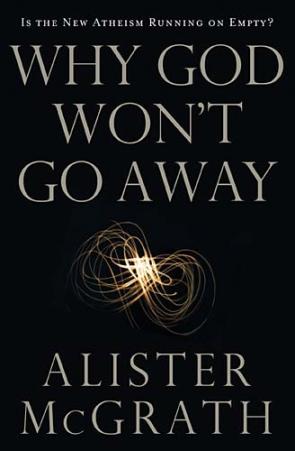
  • I’ve just read the last book of Alister McGrath, Why God Won’t Go Away: Is the New Atheism Running on Empty? (Thomas Nelson, 2010).
    I selected few thoughts, simple and in their logical framework,  but I would like to begin with the last passage of the book:

    I’d just finished giving a lecture in London early in 2010. A young man came up afterward and asked me to sign a copy of my textbook Christian Theology: An Introduction. I asked him what had led him to study theology. He told me that he’d read Richard Dawkins’s The God Delusion a year or so earlier and it seemed so unfair and one-sided that he felt he needed to hear the other side. So he started going to church. After a while he found he could not sustain his faith in the parody when confronted with the real thing. He converted to Christianity – joyfully and decisively. “Without Dawkins”, he told me, “I would never have given God a second thought.”

    As I  signed the book, the young man told me he had a theological question for me. Since The God Delusion had been instrumental in his conversion, should he thank God for Richard Dawkins in his prayers?

    I’m still thinking about that one (p. 147)

    The New Atheism movement has three leading themes: its critique of religious violence, its appeals (and monopoly) to reason and science. Let’s take them one by one, guided by Alister McGrath.

    1. Violence: when religion goes wrong

    Does religion poison everything?

    Everyone agrees that some forms of religion are bad, mad, and dangerous. But being discriminatory about religion suggest a level of maturity that being discriminatory against religion does not. (p. 62)

    “Religion”: a false universal (created by the eighteenth-century Enlightenment)

    It’s increasingly agreed that definitions of religion tend to reflect the agendas and biases of those who propose them (there is in fact still no definition of religion that commands scholarly assent) (p. 64).

    Religions and worldviews

    Alberto Toscano (in his recent analysis of the history of fanaticism – Fanaticism: On the Uses of an Idea, London: Verso, 2010) writes that religion is not the only thing to have created fanatics: politics and ideologies have, too, and continue to do so. He shows how the tension between fanaticism and reasonableness is constructed by power groups, with vested interests in mind. His analysis of the “fanaticism” of the eighteenth-century Enlightenment will make uncomfortable reading for those – such as Harris and Hitchens – who naively believe that the best hope for the human race is a return to the Enlightenment (p. 69)

    Christianity and nonviolence

    Any discussion about religious violence must take into account the inconvenient fact that Christianity offers a transcendent rationale for the resistance of violence. Christians hold that the nature of God is made known in Jesus of Nazareth, so the words and actions of Jesus reveal the character and will of God.(…) Now, I have no doubt that lots of  Christians fail to behave like this. But maybe that just shows that they are not very good Christians. Christianity will always stand in constant need of reformation (p. 69-70).

    Atheist violence against religion

    Christopher Hitchens argues that the Soviet Union was really a religious state, which explains why it was so immoral and violent (…):

    Major premise: religion is evil and violent.

    Minor premise: the Soviet Union was evil and violent.

    Conclusion: the Soviet Union was therefore religious.

    We move from fiction (“all religion is evil”) to pure fantasy (“all evil is religious”), everything being forced into the ideological mold by Hitchens’s dogged belief in the intrinsic violence and evil of religion. He does not engage with the substantial body of literature now available concerning the suppression of religion during the Soviet Union (as we read in The plot to kill God: findings from the Soviet experiment in secularization by Paul Frose, my note), or show any awareness of its implications for his somewhat problematic reading of history.

    Richard Dawkins insists that there’s “not the smallest evidence” that atheism systematically influences people to do bad things, and that does “not believe there is an atheist in the world who would bulldoze Mecca – or Chartres, York Minster or Notre Dame”. Unfortunately, this noble sentiment reflects his personal credulity rather than the reality of things (…). Dawkins has a fervent, pious, and unquestioning faith in the universal goodness of atheism that he refuses to subject to critical examination (p. 74-76)

    Secular ideals and violence

    Secular alternative to religion created

    a tendency toward intolerance and violence when such secular “objects of worship and devotion” are challenged or threatened. A good example of this development can be seen in the “Reign of Terror” of 1794 following the onset of the French Revolution, which arose directly out of the secular political ideologies of that age. (…)

    All ideals – divine, transcendent, human, or invented – are capable of being abused.(…) New Atheists tend to be a little vague about this, but they certainly seem to encourage the idea that once we get rid of religion, we get rid of some nasty violence. Ther’s just no evidence for this. Two points need to be made in response.

    First, the vicious “wars of religion” of the seventeenth century were replaced by the equally vicious but infinitely more destructive ideological and nationalistic wars of the twentieth. Thd erosion of religion as a social force in Western Europe did not lead to the peaceful coexistence imagined by the more idealistic rationalists of the Enlightenment. The First World War, as is often pointed out, had no religious dimension.

    And the second, human beings are very good as inventing ways to distinguishing themselves from other groups of human beings and allowing these difference to generate conflict. Religion is one such difference. But there are lots of others: gender, class, ethnicity, sexual orientation, language, and football. Get rid of religion, and conflict and violence will simply find other occasions for their emergence and other grounds for their justification (p. 77-79)


  • I think Oprah is John the Baptist, leading the way for Obama to win.
    Iowa voter

    Nu am să uit niciodată atmosfera Surprizelor lui Andreea Marin.

    • Diabetul discursiv,
    • vocea și gestica pseudo-angelică a prezentatoarei,
    • dramaturgia simulacrului de suspans,
    • cromatica glamuroasă,
    • alunecarea erotică a camerei de filmat pe îmbrățișările și lacrimile ce parcă dădeau organicitate și vitalitate naturii moarte a platoului de filmare,
    • mișcările scenice ale “sirenelor” din fundal, ce aveau rolul să ademenească telespectatorii libidinoși care ar fi schimbat canalul,

    toate acestea erau ingredientele unui show care a făcut istorie în România nevindecată de sine de prin anii 2000. Minutele de reclamă erau plătite din plin cu prețul unor emoții terfelite, stoarse vulgar din hăul frustrărilor și suferințelor umane. Pasiunile reale, declanșate de conspirația benevolentă a realizatorilor emisiunii, mi-au revelat nevoia teribilă de supape terapeutice pe care media vine să le ofere publicului. În lumina falselor vindecări,  bolile “boborului” își pot duce mai departe veacul. M-a oripilat falsa instituție a mărturisirii “catarhice”, stimulând foamea de mărturisirile altora, mediatizate şi dramatizate până la limita parodiei şi a patetismului ieftin, mărturisiri care să le camufleze pe ale noastre. O afectivitate bolnavă și ipocrită transpira prin fiecare lacrimă indusă de maestra manipulării grațioase.

    Cred că emisiuni ca Surprize, Surprize, Iartă-mă!, Din dragoste erau semne ale atrofierii rolului social al duhovnicului, al păstorului, și dă seamă de înlocuirea acestuia cu simulacrele postmoderne de spiritualitate și empatie socială ale mass-mediei, pliată pe interesele de rating, dar nu numai.

    Pe măsură ce studiam ceea ce eu numesc mesianism mediatic, aveam să descopăr adevărata maestră a simulacrului baudrillardian: Winfrey Oprah. Fiind an icon for church free spirituality (LaTonia Taylor), Oprah este simbolul kitchului instanțiat în capodoperă. Pentru că am importat de la americani junk food, iată că avem acum și junk spirituality, produs imediat, servit comod pe retina și memoria flămânde de facil și imediat. Iată câteva unelte de explorare a șantierului atât de sincretic, bombastic, binevoitor și totuș atât de previzibil, steril și superficial pe care W. Oprah l-a deschis în mințile atâtor americani din 1986 și până astăzi. Capitalismul spiritual al evangheliei prosperității lui Oprah este vizibil prin:

    • propovăduirea unei vieți mai bune, a unei puteri mai mari (Behave your way to success),
    • afirmare de sine (Be Yourself) împletită cu empatizare (Make the Connection),
    • spiritualizare materialistă, lucrativă (Working Spirit, Minding Your Body), dar care se poate obține/cumpăra doar prin bunurile și serviciile oferite în mixul comercial cu marca Oprah (Buying Spirit, O List),
    • misionarismul prosperității (Now our mission … is to use television to transform people’s lives, to make viewers see themselves differently, and to bring happiness and a sense of fulfillment into every house),
    • ritualul bincuvântării (These dreams are yours for the taking).

    Pentru o detaliere a acestui tip de “capitalism spiritual” recomand studiul bine argumentat și documentat al unei profesoare de la Yale, Kathryn Lofton (Oprah: The Gospel of an Icon, University of California Press, 2011)

    În abundența promisiunilor atâtor pop guru, cine mai are timp să își numere rămășițele de viață, nehăituit de demonii bunelor intenții? Cu atâția mesia portabili, maleabili, comozi, la preț redus, cronofagi care se vâră și freamătă frenetic în toate cotloanele vieții, cine mai are timp să discearnă originalul de fals?

    Oprah by David O’Keefe

  • technological fascination and totalitarianism,

    wired  imagination,

    mass-optimism, individual depression,

    cheerful innovation,

    obsessive repetition, glamorous manipulation,  lazy ecstasy and desires,  neurotic nightmares,

    transparency,  surface, serial multiplication,

    the Internet realm, all possible universes, digital jungle, new aesthetics,

    democratic access, corporate control,

    proletarian images and sounds, design addiction,

    virtual hope, real hate,

    unstable confidence, hyper-transparent love,

    on-line parenting, virtual fellowship,

    ……

    messianic expectations,

    digital worship,

    cultural soteriology,

    Electronic God.

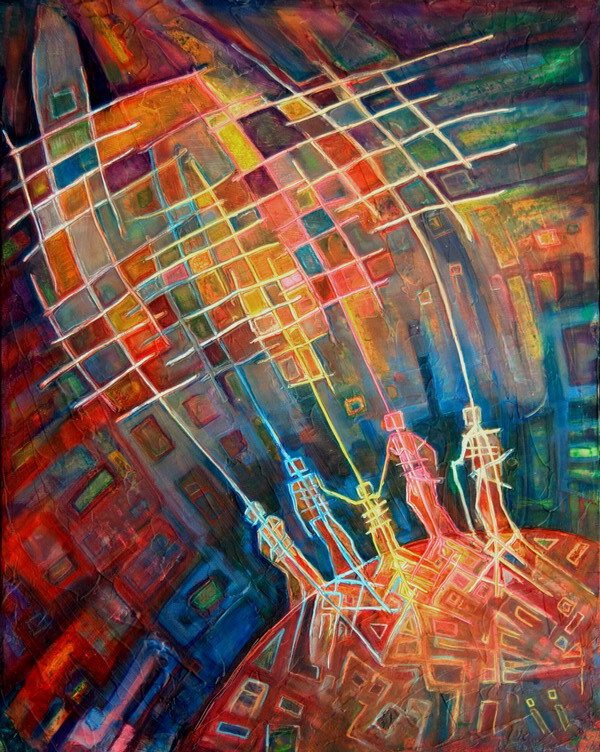
    Painting: Generation Connections by Ted Wallace

    How Technology is Influencing Families

    Barna Group recently completed a study about the influence of technology in families, releasing the findings in a new digital report, The Family & Technology Report.

    Highlights from the study included the following five findings:

    1. Parents are just as dependent on technology as are teens and tweens.

    2. Most family members, even parents, feel that technology has been a positive influence on their families.

    3. Very few adults or youth take substantial breaks from technology.

    4. Families experience conflict about technology, but not in predictable ways.

    5. Few families have experienced—or expect—churches to address technology.

    Details – HERE.