
• And what rough beast, its hour come round at last,
    Slouches towards Bethlehem to be born?

    (The Second Coming, William Butler Yeats)

    (an old article that I found actual nowadays, in 2025 – this is a translation of my article, written in Romanian, December 20, 2016)

    The Twitches of the Electric Eye

    The seasonal consumerist whims of one part of the world are spiced with moments of emotional hangover in the retina worn out by the horrors from the other part of the world. The abandoned supermarket cart in an American parking lot arrogantly echoes the rusty remains of cars used in the desperate flight of the hopeless among the ruins of Aleppo. In fact, the human monstrosity virtually consumed in Western teenagers’ video games brands itself live into the nerves, skin, and cries of the dying in Syria and beyond.

    Aleppo is not only the signature of Obama’s failure on the certificate of his Nobel Peace Prize, but also the bleeding wound of humanity—one that might compel Fukuyama to revise his thesis on the end of history. History ends when its subject capitulates to its own toxic genetic fountain—one that no educational or transhumanist utopia can alter. Anywhere, anytime, the Cain-virus within us lies in wait to fuel our fratricidal violence. And that’s because we were first infected with the virus of deicidal violence.

    When horror from there becomes horror here, the heavy eyelids of Western toil and entertainment snap open in wonder and fear. The year 2016 was a more hurried trickle of the horrors of 2015. The flood of breaking news staining not just the screens but also the world’s streets competed with the flashes of celebrity culture that feed the therapeutic dreams of consumers resisting the ever-growing temptation to escape into the reality of psychotropics. Over 700 overdose deaths in the first 11 months of 2016 in British Columbia—Canada (with a population just slightly larger than Bucharest’s)—became a macabre chorus accompanying the voice of millions of souls torn from their bodies—abortions, murders, diseases, wars. The world grows ever more unbreathable. And as a parent looking around with both eyes, you feel a pang in your chest seeing what waves of horror await your children in the years to come.


    The Mutant Re-Birth

    2016 brought an increased surge of migratory waves that shattered the fragile goodwill and hope in humanity—brutalized serenities, arrogant lies, hysterics, and forced steps into the barracks of fear. The modern human keeps trying to deny the obvious, to project convenient guilt, to edit the language of horrors in the hope they’ll lose their ontological referent. He self-encapsulates in false penances just as much as he lays hands on ritual scapegoats, hoping it’s all just an accident of brain chemistry, global warming, socio-economic or gender inequality, shoe size or underwear color—a divine whim with no chance of real existence. The surprise is that this astonishing capacity for self-deception is powerless in the face of a reality that greedily tears with iron teeth into the frail body of what remains of optimism and innocence.

    The secular man, living under the shadow of a bizarre mix of voluntary consumerism and activist Marxist utopias, finds himself speaking more and more about apocalypse, fear, and metaphysical dread.

    A striking example of this apocalyptic fear is the persistence with which William Butler Yeats’ poem, written near the time of the First World War, circulated across 2016 social media:

    Turning and turning in the widening gyre
    The falcon cannot hear the falconer;
    Things fall apart; the center cannot hold;
    Mere anarchy is loosed upon the world,
    The blood-dimmed tide is loosed, and everywhere
    The ceremony of innocence is drowned;
    The best lack all conviction, while the worst
    Are full of passionate intensity.

    Surely some revelation is at hand;
    Surely the Second Coming is at hand.
    The Second Coming! Hardly are those words out
    When a vast image out of Spiritus Mundi
    Troubles my sight: somewhere in sands of the desert
    A shape with lion body and the head of a man,
    A gaze blank and pitiless as the sun,
    Is moving its slow thighs, while all about it
    Reel shadows of the indignant desert birds.
    The darkness drops again; but now I know
    That twenty centuries of stony sleep
    Were vexed to nightmare by a rocking cradle,
    And what rough beast, its hour come round at last,
    Slouches towards Bethlehem to be born?

    (William Butler Yeats, The Second Coming, January 1919)


    The vortex of history brings us back to the place the world departed from 2000 years ago. (The first verse speaks of a spiral—gyre—that leads us to the last two verses, which depict the mutant rebirth at Bethlehem—a distorted, inverted Messiah: the Antichrist). Because creation can no longer hear the Creator (The falcon cannot hear the falconer), the world has lost its center (the center cannot hold), and anarchy spreads across the wrinkled face of the earth (mere anarchy is loosed upon the world). The absence of conviction allows for the rise of the most violent ideologies (The best lack all conviction, while the worst/ Are full of passionate intensity), a premonition of the value-vortex of postmodern relativism and nihilism—glorified in universities, media, and culture—which drives youth into the arms of all sorts of militant extremisms. Over the grave-like silence of the past twenty centuries rises the shadow of a beast seeking birth—as a false messianic imitation—at Bethlehem.

    The birth of Christ at Bethlehem in the context of a maniacal killer like Herod speaks volumes: even God begins with what is vulnerable, frail, unstable, and under threat from the “good” as conceived and executed by the human mind. We certainly cannot envy the times in which the Son of God was born, hunted by a diabolical beast like Herod, who manipulated society on his fingers, killed his own family out of paranoia while feigning benevolence and charity, and so on. Yet our times seem increasingly to resemble that same crossroads of eternity.

    Our great problem today is that we’ve amputated our sense of the transcendent, anesthetized our organ for converting suffering into self-becoming, and locked ourselves in the asylum of utopian, odorless, and colorless ideas. The ecstasy of autistic pleasures has now melted into a dark and intoxicating spasm of a mutant rebirth—a Martian Jesus, a Santa Claus, a replicated Mephistopheles present everywhere, lost souls, failed DNA strands, all caught in the song of a new world’s creation—a humanity, a destiny—a creation that can only unfold through destruction, violence, degenerative life, and agonizing death.
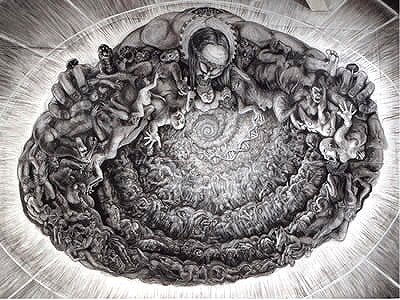
    The Widening Gyre by Emily Tellez

    Beyond the Apocalypse

    In March 1996, Umberto Eco wrote a letter to his friend Carlo Maria Martini titled “The Secular Obsession with a New Apocalypse” (included in their dialogue collection What Do Those Who Do Not Believe Believe In?, Polirom, 2011, Romanian version; the English version is Belief or Nonbelief?, published in 2000 at Arcade Publishing). Eco rightly observes:

    Today we live (even in the distracted, absent-minded way that mass media have taught us) our own terrors of the end; we could even say we live them in the spirit of bibamus, edamus, cras moriemur—celebrating the end of ideologies and solidarity in the whirlpool of an irresponsible “consumerism.” Thus, each of us plays with the fantasy of the Apocalypse while simultaneously trying to exorcise it; the more we exorcise it, the more our unconscious fear of this fantasy grows, one we project in the form of a bloody spectacle in hopes that it will thereby become unreal. Yet the strength of phantoms lies precisely in their unreality.

    […] I dare say that concern for the end times is today more characteristic of the secular world than of the Christian one. In other words, the Christian world treats it as a subject of meditation but behaves as if its projection into a timeless dimension were justified; the secular world pretends to ignore it, yet is genuinely obsessed with it. This is not a paradoxical situation, for it merely repeats everything that happened in the first millennium. (In What Do Those Who Do Not Believe Believe?, pp. 13–14)

    Eco concludes his meditation on the secular obsession with the apocalypse by intuiting the Christian interpretive key to Revelation:

    Christianity invented history, and the modern Antichrist denounces it as a disease. Perhaps secular historicism understood this history as infinitely perfectible, so that tomorrow would always surpass today, constantly and without exception, and within that same history, God himself would transform—educate and enrich himself, so to speak. But this ideology does not belong to the entire secular world, which has also seen the madness and decline strewn across history; there is nonetheless a distinctively Christian vision of history whenever that path is traveled under the sign of Hope. Thus, only by learning to judge history and its horrors are we fundamentally Christian—when we speak of tragic optimism, with Mounier, or of the pessimism of reason and the optimism of the will, with Gramsci. (What Do Those Who Do Not Believe Believe In?, pp. 15–16)
  • Philosophical Foundations (a. Ancient Roots)

    The Age of Intellectual Maturity

    In The Republic (Book VII, 539b-540a), Plato discusses the age and maturity necessary for one to attain the status of a philosopher. Beyond a contrarian, superficial, or mimetic spirit, a thinker truly becomes a philosopher only when he surpasses the stage of immaturity (to use Kantian terms), characterized by an unjustified, reckless, and uncontrolled use of the dialectical and contrarian spirit:

    “539B For I presume you have noticed that youngsters, when they first get a taste of dialectic, misuse it as if it was their plaything, by using it always to come up with counterarguments. They themselves imitate those who engage in refutation, by refuting other people, taking delight, like puppies, in verbally tugging at and pulling apart anyone who ever comes near them.”
    […]
    “And so, when they themselves have refuted many, and have been refuted 539C by many, they descend rapidly and inexorably to a state where they believe nothing they believed before, and as a consequence they themselves, and philosophy in general, are held in low regard by everyone else.” (539B, C)

    In ancient Greece, the optimal age to begin engaging in philosophy was around 40 years old, following intense cultivation of the mind through mathematical exercises and of the body through athletic training. Aristotle also speaks of the optimal age for philosophizing—around 40 years old—situated between the impulsiveness of youth and the cynicism of old age (Rhetoric, Book II, Chapter 14). This is because practical intelligence (phronesis) is required. According to Aristotle, this should be the peak, the optimal age of balance (mesótēs)—courageous but not recklessly daring, prudent but not timid.

    Perhaps the deplorable state of today’s public intellectuals, despite the spectacle and public reputation of some figures within the intellectual class, can be explained by the failure to adhere to these minimal conditions prescribed to us for so long.

    Philosophy and Democracy – The Twin Pillars of Intellectual Spirit

    But let us go even further back in history, beyond Aristotle and Plato, to the turbulent era of democracy’s birth, which, to a great extent, coincides with the birth of philosophy. According to French scholars Marcel Detienne and Jean-Pierre Vernant, the transition from mythical, exclusively lyrical and poetic thought—used to justify centralized, authoritarian, and hierarchical power structures (as seen in the dominance of despots, aristocrats, and monarchy in the pre-philosophical era)—to philosophical, rational thought centered not around the word of power (mythos), but the power of the word (logos), was a crucial shift. This transition led to open, interrogative, and participatory discourse, resembling the agora, reflecting the symmetry of the cosmos (an order that implies reason and harmony) (see Jean-Pierre Vernant, Myth and Thought in Ancient Greece; Marcel Detienne, The Masters of Truth in Archaic Greece).

    The decline of aristocratic and despotic authority in the 6th century BCE, which had justified itself through grand mythological narratives and hierarchical power structures, made way for the city-state (polis), organized around the citizens’ freedom to express opinions, open critique, public participation, and debate. The rationalization of religious experience and mythological traditions gave birth to classical Greek philosophy (J.-P. Vernant), just as the concept of truth shifted from poetic and religious experience to a philosophical one—open to debate and consensual acceptance based on reason and rational arguments (M. Detienne).

    Note: I will discuss the limitations of this explanatory model when referring to the acrobats of reason in the Greek demos, the sophists, and their present-day counterparts.

    In this context, an intellectual is neither a poet nor a priest, but a craftsman of possibilities, a handler of rational truth—a mind that perceives its own limitations just as it perceives those of others. The intellectual negotiates options in the public sphere with those holding different opinions and perspectives. An intellectual is an advocate of dialogue, not of authoritarian refusal to justify beliefs or to appeal to reason – understood as an intersubjective means of discussing individual absolutes.

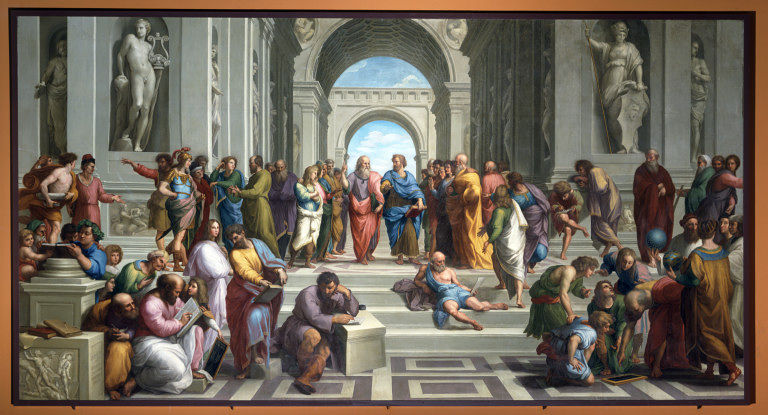
    Raphael, The School of Athens, 1508

    However, history offers us a fascinating spectacle: the journey from the stage of independence and adolescent optimism (pre-Socratic philosophers up to Socrates), through the classical, emphatic, stable maturity of philosophy (Plato, Aristotle), to the senility of ancient philosophy—consumed either by Roman philosophical cynicism, Greek atheistic Epicureanism, or the religious mysticism of Neoplatonic sects. A cycle that will repeat, in some form, in modern times: breaking free from the paternalistic captivity of medieval Christian Scholasticism, modern philosophy rises like a vigorous and optimistic young force during the Enlightenment, championing reason (or sensory experience)—with Kant playing the synthesizing role that Plato had in antiquity (albeit delivering a fatal blow to philosophy). It then enters the senility of postmodern cynicism, displaying a religious fervor, visible even in its passionate anti-religiosity.

    Are we now living in a time of intellectual revival, rekindling the rational spirit after the nihilistic hangover of postmodern heresies?

    Before approaching the modern era, however, we must first spend more time in Plato’s domain—the first true advocate of the public intellectual, the one who sought to dominate society through the power of reason and moral example. Here, we will observe both the grandeur and corruption that history unfolds before our eyes, with the hope that we may learn something from it…

  • 1. Temeliile filosofice (a. ceva radacini antice)

    Varsta maturitatii intelectuale

    In Republica (Cartea a VII-a, 539b-540a), Platon vorbeste despre varsta si maturitatea indispensabile statutului unui filosof. Dincolo de spiritul contrarian, superficial, mimetic, un ganditor devine filosof atunci cand depaseste statutul imaturitatii (sa vorbim in termeni kantiani), al folosirii nejustificate, imprudente, necontrolate a spiritului dialectic, contrarian:

    “539B For I presume you have noticed that youngsters, when they first get a taste of dialectic, misuse it as if it was their plaything, by using it always to come up with counterarguments. They themselves imitate those who engage in refutation, by refuting other people, taking delight, like puppies, in verbally tugging at and pulling apart anyone who ever comes near them.” […] “And so, when they themselves have refuted many, and have been refuted 539C by many, they descend rapidly and inexorably to a state where they believe nothing they believed before, and as a consequence they themselves, and philosophy in general, are held in low regard by everyone else.” (539B, C).

    Varsta optima pentru a incepe a filosofa, in Grecia antica, era in jurul varstei de 40 de ani, dupa o cultivare intensa a mintii prin exercitii matematice si a trupului prin travaliu atletic. Aristotel vorbeste si el despre varsta optima a filosofarii, in jurul varstei de 40, incadrata intre impulsivitatea tineretii si cinismul batranetii (Retorica, cartea a  II-a, capitolul 14) tocmai pentru ca e nevoie de inteligenta practica (phronesis). Aceasta ar trebui sa fie, potrivit lui Aristotel, apogeul, varsta optima, a echilibrului (mesótēs) – curajos dar nu riscant peste masura, prudent dar nu timid.

    Poate ca starea deplorabila a intelectualilor publici de astazi, in ciuda spectacolului si reputatiei publice a unor exponenti ai clasei intelectuale, poate fi explicata recurgand la nerespectarea acestor minime conditii pe care le avem prescrise de atat de multa vreme.  

    Filosofia si democratia – gemenii spiritului intelectual

    Dar as merge insa oleaca mai departe in istorie, dincolo de Aristotel si Platon, in epoca turbulenta a nasterii democratiei care, in buna masura, coincide cu nasterea filosofiei. Conform eruditilor francezi Marcel Detienne si Jen-Pierre Vernant, tranzitia de la gandirea mitica, exclusiv lirica, poetica, justificand strucuri de putere centralizate, autoritare, a gandirii ierarhice – vezi dominatia despotilor, aristocratilor si a regalitatii in epoca pre-filosofica, la cea filosofica, rationala, ordonata in jurul nu al cuvantului puterii (mythos) ci a puterii cuvantului (logos), a discursului rational deschis, interogativ, participatoriu, asemena agorei, care reflecta simetria cosmosului (armonia ce implica o ratiune, ordine) (vezi Jean-Pierre Vernant, Mit si gandire in Grecia Antica, Marcel Detienne, Stapanitorii de adevar in Grecia arhaica). Declinul autoritatii aristocratic-despotice, in secolul 6 i. Hr., ce se justifica prin apelul la naratiunile maximale, mitologice, bazate pe argumentul autoritatii si al ierarhiei structurilor de putere, face loc orasului stat care se organizeaza in jurul libertatii cetanilor de a-si exprima opiniile, a criticii libere, a participarii cetatenilor si dezbatelor publice. Rationalizarea experientei religioase si a traditiilor mitologice da nastere filosofiei clasice grecesti (J.P Vernant), la fel cum conceptul de adevar se misca dinspre experienta poetica si religioasa inspre cea filosofica, deschisa dezbaterii si acceptate consensual pe baza ratiunii, a argumentelor rationale (M. Detienne). 

    Nota: voi vorbi depre limitele acesti model explicativ cand ma voi referi la saltimbacii ratiunii in demosul grecesc, sofistii, si corespondentul lor actual.

    In acest context, un intelectual nu e poet, nici preot, ci un artisan al posibilului, manuitor al adevarului rational, o minte ce isi percepe propria limitare in aceeasi masura in care o percepe pe cea a altora si negociaza optiuni in sfera publica cu cei care au diferite opinii si viziuni. Un intelectual e apologetul dialogului, nu al refuzului autoritar de a justifica sau face apel la ratiune – ca modalitate intresubiectiva de a comunica si discuta absoluturile individuale.

    Rafaelo, Scoala din Atena (1508)

    Vom vedea insa ca istoria ne ofera spectacolul captivant al trecerii de la etapa independentei si optimismului adolescentin (pre-socraticii pana la Socrate), trecand prin cea a maturizarii clasice, emfatice, sigure, stabile (Platon, Aristotel), catre cea a senilitatii filosofiei antice, ce se va auto-consuma in cinismul filosofic roman si cel ateu-epicurean grecesc sau in cel religios al sectelor neo-platonice. Procesualitate care se va repeta, intr-o forma sau alta, in epoca moderna – evadand din captivitatea paternalista a Scolasticii crestine medievale, filosofia moderna se va ridica ca o tanara faptura viguroasa si optimista in epoca Iluminismului, fiind avocatul apelului la ratiune (sau simturi) (Kant jucand rolul de sintetizator pe care Platon l-a jucat in antichitate, insa cu o lovitura mortala data filosofiei), pentru ca apoi sa ajunga in epoca senilitatii post-moderne, a cinismului pesimist si vadit religios chiar prin anti-regiolizitatea pasionala afisata peste tot.

    Sa traim acum o vreme a revigorarii intelectuale, a aprinderii spiritului rational, dupa mahmureala nihilista a ereziilor postmoderne?

    Inainte insa de a ne apropria de epoca moderna, va trebui sa poposim mai mult in batatura lui Platon, ca primul apologet al intelectualului public, cel care domina societatea prin puterea ratiunii si examplul moral. Vom vedea aici semnele maretiei si coruptiei pe care istoria le va desfasura in fata ochilor nostri cu speranta ca poate vom invata ceva din ea…

  • Prolegomena for an uncomfortable exercise

    In Matthew 15:14, Jesus, the carpenter from a dusty little village in northern ancient Israel, just had a confrontation with the Pharisees and scribes who had come all the way from Jerusalem. When his disciples expressed some concerns that their teacher had offended these highly respected intellectual elites, Jesus responded: “Leave them; they are blind guides. If the blind lead the blind, both will fall into a pit.” (NIV)

    Beyond what we might today label as abrupt, impolite, or even obtuse rhetoric, the core issue here resonates with a theme later picked up (reversed, upside-down, in an self-glorifying, narcissistic manner) by the Enlightenment: what happens when intellectuals—those meant to bring the light of revelation or reason—willingly wallow in the darkness of their own blindness and ignorance?

    Setting aside the all-too-convenient interpretation of this passage as some sort of anti-intellectualist stance, often exploited for mercantile or political purposes, we are left with an inescapable fundamental question: what happens to the rest of us—the public, the common people—when the so-called beacons of intellectual and spiritual light fail to fulfill their mission? From the biblical text, we see that Jesus not only critiques these intellectuals’ inability to perceive the light but also highlights conformism, the herd mentality that thrived within the so-called “intellectual community” of his time.

    On that note, the Gospels do offer positive examples of highly esteemed, intelligent, and publicly reputable figures who were received—and even appreciated—by Jesus. Think of Nicodemus, Joseph of Arimathea, and other Pharisees who believed in secret. Yet, in every instance, these individuals were overshadowed by their fear of being ostracized and punished by their own community. So, the next time a young person says the Gospels aren’t cool or that there’s nothing in them worthy of a rebellion against “the system”, they might want to take another look.

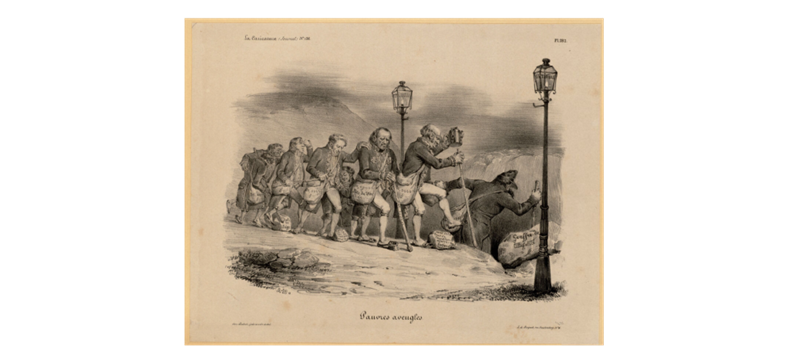
    Blind Leading the Blind (Povre Aveugles) by Auguste Desperret, mid 1800s

    So, how should we evaluate the performance, value, and public role of intellectuals in our time?

    I will attempt to bring some light to this matter as someone who, despite a personal diminished public profile in recent years, has remained connected to the flow of ideas and the public spectacle in North America and, through various channels, to that of Romania. This distance has given me the ability to observe trends and shifts—sometimes abrupt ones—in positions and justifications I never expected to hear from individuals of strong intellectual and moral standing.

    What is happening to intellectuals (some, but not a few) and the light they claim to carry, only to end up blind, as in the biblical passage? Is that light illusory, toxic, a hybrid darkness disguised as illumination? Is it something about how they receive and process that light? Or is it possible that we, those meant to receive their wise counsel, lack the light to perceive their light? (Perhaps that is why the psalmist says, “In Your light, we see light”—Psalm 36:9. This, I believe, is the precondition of the intellectual, as it is for anyone else: humility, an honest awareness of one’s limitations, and a willingness to receive before attempting to give to others. If we do not consider the Bible a serious source, then let us turn to Socrates, who spoke of the same principle—awareness of one’s own ignorance as the precondition for the path to knowledge. A “I know that I know nothing” does not sit well with today’s polished rhetoric, refined oratory, or intellectual elitism—hence why the Romanian playwright I. L. Caragiale remains so relevant!)

    This endeavor will require, first and foremost, some archaeological and diagnostic work, examining the history of the “patient.” Additionally, we will undertake efforts to explore therapeutic options, preventing ourselves from becoming—or deconverting from the status of—the blind leading the blind while believing ourselves to be the bearers of light.

    In other words, my approach aims to clarify the status and mandate of the intellectual in the public sphere, following a very simple structure:

    1. Philosophical Foundations

    Defining the public intellectual while outlining the philosophical underpinnings of various available options in the public arena.

    1. What is a public intellectual?
    2. Who are the intellectuals whose voices dominate the public space?
    3. What explicit motivations, standards, and justifications do these intellectuals offer us?

    This will be an uncomfortable and risky exercise in shedding some light on those who teach us how to direct light onto others.

    2. The Ideological Clone Factory

    A call for honesty, with an insistent look at the mechanisms shaping public opinion.

    1. How is consensus manufactured (to borrow Noam Chomsky’s phrase)?
    2. What forces and tools are used to standardize and reshape cultural climates?
    3. How do mental toys (a.k.a. ideological preciousness) trickle down from university professors into media, schools, public discourse, and even private family discussions, parasitizing our thinking, capturing public opinion, and subtly censoring our ability to think divergently—or even contradictorily?

    3. Lessons from the Past

    A radiography of the great moral failures of intellectuals who have become instruments of ideological uniformity and political forces.

    1. How can we analyze past intellectual servility and prostitution, not with resentment, but as a lesson for understanding the same dynamics in today’s world?
    2. In contrast, we will take a look at some intellectuals who maintained integrity, character, and independence. They might play as role models for us, here and now.

    4. What Is to Be Done?

    A possible therapeutic roadmap—one I present for debate—in the hope that we can reach a minimal ethical standard for those who consider themselves intellectuals and engage in socio-cultural engineering.

    1. What are the minimum intellectual hygiene conditions that should be met before we grab the megaphone and preach to others?

    Before diving into this analysis, I must clarify that this exercise is strictly surgical—a methodological demonstration for analysis and evaluation, avoiding direct applications to particular contemporary events. I will intentionally refrain from referencing current affairs so as not to get caught up in the partisan passions of daily politics.

    My intent is as academic and invitational as possible. That being said, we will walk hand in hand through the DO’s and DON’Ts of intellectual discourse, with the guidance of J. Benda, M. Foucault, A. Gramsci, K. Marx, J. Dewey, R. Rorty, Z. Bauman, J. Kristeva, S. Žižek, A. Davis, J. Butler, R. Aron, A. Bloom, M. Heidegger, J.-P. Sartre, B. Weiss, T. Sowell, J.S. Mill, H. Marcuse, and others. (Notice the overwhelming dominance of intellectuals with a particular philosophical and ideological orientation—this is an intentional move, a playful deconstruction, an argumentative inversion, a dialectical reversal—see ἐνθύμημα – enthymeme, as recommended by Aristotle over two thousand years ago.)

    Perhaps my effort will open bridges—not only of communication but also of divergent, freer, and more independent analysis, so necessary to the intellectual condition.

    After all, was the Garden of Eden ever really a safe place for Adam and Eve?

    To be continued…

  • Prolegomene pentru un exercitiu incomod

    In Matei 15:14 Isus, tamplarul din satucul prafuit din nordul Israelului antic, tocmai se certase cu fariseii si carturarii veniti in vizita tocmai din Ierusalim. In contextul in care ucenicii lui erau ingrijorati ca invatatorul lor tocmai a ofensat acesti respectabili sus-pusi intelectuali, Isus le replica: Lăsaţi-i: sunt nişte călăuze oarbe; şi când un orb călăuzeşte pe un alt orb, vor cădea amândoi în groapă.

    Poate ca dincolo de stilul abrupt, nepoliticos and obtuz cu care l-am eticheta azi pe Isus, discutia este in jurul ideii care va fi apoi preluata (rasturnata, inversata imagologic-narcisist) de Iluminism: ce e de facut cand intelectualii, care ar trebui sa aduca lumina revelatiei/ratiunii, sunt cei care se zbat satisfacuti in intunericul propriei orbiri si ignorante? Dincolo de optiunea facila a interpretarii acestui pasaj in favoarea unui anti-intelectualism cu vadite interese mercantilist-politice, exista o problema fundamentala pe care nu o putem nega: ce se intampla cu noi, ceilalti, publicul sau plebea, cand farurile de lumina intelectuala si spirituala inceteaza sa isi implineasca misiunea/functia? Din textul biblic putem intelege ca Isus se refera la atat inabilitatea acelor intelectuali de a vedea lumina, dar si la elementul de conformism, de mentalitatea de turma care domnea bine merci prin mediile “comunitatii intelectuale” din acele timpuri. Apropos, Evangheliile ne prezinta si exemple pozitive ale unor oameni sus-pusi, cu vadite calitati intelectuale exceptionale si cu impecabila prestanta publica, care sunt primiti si chiar apreciati de Isus (referinta biblica merge in dreptul unui Nicodim, Iosif din Arimateea si alti farisei care credeau “pe ascuns”), dar de fiecare data aceste profile umane sunt umbrite de teama de a fi izolati si pedepsiti de propria comunitate. Sa nu mai spuna vreun tanar ca Evangheliile nu sunt cool si nu e nimic demn de o rebeliune impotriva “sistemului” pe acolo!

    Blind Leading the Blind (Povre Aveugles) by Auguste Desperret, mid 1800s

    Asadar, cum sa evaluam prestanta, valoarea si rolul public al intelectualilor in timpurile noastre?

    Voi incerca sa aduc ceva “lumina” in acesta chestiune, ca unul care, in ciuda diminuarii profilului public in ultimii ani, am ramas conectat la fluxul de idei si spectacolul public de prin America din Nord si, prin varii canale, la cel din Romania. Aceasta distantare mi-a oferit posibilitatea de a vedea tendinte si schimbari, cateodata bruste, ale unor optiuni si justificari pe care nu am crezut ca le voi auzi de la oameni cu o buna prestanta intelectuala si morala. Oare ce se intampla cu intelectualii (unii, dar nu putini) si lumina pe care o tin de ajung orbi, ca in pericopa biblica? Este acea lumina iluzorie, toxica, un intuneric hibrid, camuflat ca lumina? Este ceva ce tine de modul in care ei primesc si proceseaza acea lumina? Sau poate ca noi, cei care ar trebui sa le primim sfaturile intelepte, nu avem lumina pentru a le vedea lumina?!? (poate ca de aceea psalmistul spune ca de fapt prin lumina Ta vedem lumina (Psalmul 36:9). Aceasta este, cred eu, preconditia intelectualului, ca de altfel al oricarui altcuiva: umilinta, o onestitate peratologica – constientizare a limitelor, disponibilitatea de primi  pentru ca apoi sa dea si altora! Daca nu consideram Biblia ca fiind o sursa seriosa, sa luam atunci citire la nenea Socrate, care vorbea despre acelasi principiu al constientizarii propriei ignorante ca pre-conditie a drumului catre cunoastere. Un “stiu ca nu stiu nimic” nu ar pica bine la papionele, barbijoanele si scriitura sau oratoria finuta de azi – de aceea Caragiale e intotdeauna actual!)

    Acest demers va necesita mai intai anumite operatiuni arheologice si de diagnosticare, facand referinta la istoricul pacientului. Suplimentar, vom continua cu ceva eforturi de considerare a optiunilor terapeutice pentru a nu ajunge sau pentru a ne “deconverti” de la statutul de orb care calauzeste pe alti orbi in timp ce se vede ca detinator al luminii! Cu alte cuvinte, demersul pe care il initiez aici se vrea o clarificare a statutului si mandatului unui intelectual in scena publica urmand o procesualitate foarte simpla:

    1. Temelii filosofice – definirea intelectualului public, impreuna cu delinearea fundatiei filosofice a diferitelor optiuni pe care le avem in arena publica. Cu alte cuvinte: ce este un intelectual public, cine sunt intelectualii ale caror voce o auzim in spatiul public? Ce motivatii explicite, ce standarde si justificari acesti intelectuali publici ne ofera? Sa facem un exercitiu incomod si riscant in a aduce ceva lumina pe cei care invata cum sa punem lumina/reflectoarele pe altii!
    2. Fabrica clonelor ideologice – o invitatie la o onestitate, cu o ocheada insistenta a mecanismelor de influentare a curentelor/scolilor de gandire care influenteaza opinia publica. Cu alte cuvinte: cum se fabrica consensul (ca sa folosim o expresie a lui Noam Chomsky), care sunt mecanismele folosite de varii forte in a uniformiza si schimba climatul cultural? Cum jucariile mentale (a.k.a. pretiozitati ideologice) ale unor profesori din universitati se preling vascos prin canalele media, scoli, forumuri si discutii in familie si cercuri de prieteni pentru a ne parazita gandirea, captura opinia publica, cenzura abilitatea de a gandi divergent si chiar contradictoriu.
    3. Lectii din trecut – o radiografie a principalelor esecuri morale ale unor intelectuali care au devenit vectori ai uniformizarii ideologice, instrumente eficiente ale fortelor politice. Cu alte cuvinte: sa privim atent si fara ura in trecut pentru a intelege avalansa de servilism si prostitutie intelectuala din prezent, in contrast cu exemple relevante ale unor intelectuali care si-au pastrat prestanta, caracterul si independenta.
    4. Ce e de facut? este o posibila schema terapeutica pe care o deschid spre analiza, in speranta ca vom putea ajunge la un minimum de principii si valori pe care cei care se considera intelectuali are trebui sa le urmeze si respecte atunci cand se angajeaza in operatiuni de inginerie socio-culturala. Cu alte cuvine: oare care sunt conditiile igienice minimale cu privire la ce trebuie sa gandim mai intai, inainte de a ne deschide portavocea spre altii?

    Inainte de a plonja in acest demers vreau sa fac precizarea ca acest exercitiu este unul strict chirurgical, ca o demonstratie de stabilire a unei metodologii de analiza si evaluare, fara a intra in aplicatii directe ale acestei metodologii la fenomene particulare. Voi evita intentionat referirile la evenimente actuale tocmai pentru a nu intra in jocul partizan al pasiunilor cotidiene. Intentia mea este cat se poate de explicit academica si invitationala. Pentru asta, vom trece insa prin manualul de DO’S and DON’TS, de manuta cu J. Benda, M. Foucault, A. Gramci, K. Marx, J. Dewey, R. Rorty, Z. Bauman, J. Kristeva, S. Žižek, A. Davis, J. Butler, R. Aron, A. Bloom, M. Heidegger, J. P. Satre, B. Weiss, T. Sowell, J. St. Mill, H. Marcuse si altii (de vazut proportia covarsitoare a intelectualilor de o anumita preferinta filosofica si ideologica – act intentional, de destructurare jucausa, de folosire a argumentarii inversate, dialectice vezi ἐνθύμημα – enthymeme – pe care ne-a recomandat-o Aristotel mai mult de 2000 de ani in urma).

    Poate ca efortul meu va deschide punti nu doar de comunicare, dar si de analiza divergenta, mai libera si indepedenta, atat de necesare pentru ceea ce numim conditia unui intelectual. Pana la urma, a fost gradina din Eden un “safe place” pentru Adam si Eva?

    to be continued