
• Suicidul bisericii liberale

    Despre câteva dintre patologiile fundamentaliștilor creștini am vorbit cu o altă ocazie (Sclavii credinței), rămânând dator cu întoarcerea reflectorului către cealaltă parte, cea a liberalismului ”creștin” și a bolilor pe care acesta le ascunde sub epiderma sa emancipată. De fapt, în seria de articole Credința fără iluzii am urmărit și comentat cartea lui Andrew Byers, Faith without illusions. Following Jesus as a cynic-saint (IVP, 2011), scrisă ca un răspuns la ”emanciparea” tinerei generații. Ieșirea dintr-un evanghelism anchilozat în conservatorism mai degrabă cultural  decât dogmatic se face zbughind în direcția opusă, către un ”Pop-Christianity” liberal, cinic, supus exigențelor  pieței, a adevărurilor convenabile și decise prin presiunea numărului, a cantitativului. Ar fi interesantă o analiză a liberalismului trendy al multor în/des/”bisericiți” de prin România și, mai ales, fabrica dezvrăjirii sau a evadării din patologiile fundamentaliste pentru a se ”odihni” suav  în brațele largi ale cinismului, ale unor forme de nihilism hermeneutic și unei relaxări a practicilor morale, mulate după  etalonul valorilor și al practicilor sociale contemporane. Cred că merită efortul de a analiza procesul de (de)construcție a unei identități tributare mai degrabă fluidității și cosmeticii sociale decât stâncii care este Hristos, Același ieri, azi și în veci.

    Tocmai mi-a trecut prin mâini The Empty Church. The Suicide of Liberal Christianity (Thomas C. Reeves, The Free Press, New York, 1996).

    Bisericile protestante tradiționale din America au fost supuse unui proces de liberalizare a leadership-ului, ceea ce dus la o deformare a credinței și practicii eclesiale în funcție de interesele politice ale cetății, intererese ”progresiste” (multiculturalism, secularism, feminism, ordinarea homosexualilor, evoluționism, etc.). Dinamica bisericilor care au renunțat la cerințele inconfortabile ale adevărului biblic în favoarea unei dragoste așa zis atotcuprinzătoare, această dinamică duce inevitabil la pierderea atât a adevărului cât și a dragostei, fără de care nu poate fi conceput creștinismul ca mod de gândire, simțire și trăire. Aceste biserici încă nu au ieșit din ”Iluminism”!

    C. S. Lewis ne avertiza cu ceva timp în urmă:

    “Did you ever meet, or hear of, anyone who was converted from skepticism to a ‘liberal’ or ‘demythologised’ Christianity? I think that when unbelievers come in at all, they come in a good deal further” (C. S. Lewis, Letters to Malcolm: Chiefly on Prayer, Mariner Books, New York, 2002, p. 119)

    După un deceniu de la apariția The Empty Church. The Suicide of Liberal Christianity, autorul Thomas C. Reeves revine cu o evaluare a tezelor sale:

    A dozen years ago, I published The Empty Church: The Suicide of Liberal Christianity. It was a comprehensive analysis of the mainline Protestant churches in this country, showing that the future of the Episcopalians, Presbyterians, Lutherans (ELCA), Methodists and the others were limited to the degree that they echoed trendy values and demanded little of members, spiritually, morally, and financially. A new study published by the Pew Forum on Religion and Public Life has confirmed my prediction, and has gone on to describe other churches in the United States as well. While the survey is long on numbers and short on explanations, it contains some surprises.About 26.3% of Americans belong to evangelical Protestant churches. Catholics place second with 23.9%. Then come the mainline Protestant churches with 18.1%, followed by the historically black churches (6.9%), Jewish (1.7%), Mormon (1.7%), Muslims (0.6%), and the Orthodox (0.6%).

    Fifty one percent of the members in the mainline churches are 50 and older, and the percentage of young people identifying with them is low. In short, as I observed in 1996, these once dominant church bodies are dying out. The authentic faith is about matters far deeper than social work, the nanny state, and contemporary left wing politics. Brilliant young Bishop Hilarion of the Russian Orthodox Church said recently, “Politically correct Christianity will die.”

    The Pew study shows that secularism is booming in America, as it is throughout the West. Some 16% of Americans are religiously unaffiliated, an all-time high. (The unaffiliated are reliable Democratic voters. People who are religious and married tend to vote Republican. See Karlyn Bowman and Ruy Teixeira, “The Search for the Next Soccer Mom,” in the Wall Street Journal, February 28, 2008.) Still, the nation has not gone to the extreme that one encounters in Old Europe. Some 60% of Americans say that religion is “very important” to them, while only 12% of the French and 25% of Italians respond in the same way.

    The Pew data show Americans switching churches a lot; 44% of Americans have done this at some point. It difficult to gauge the significance of this motion. Theological ignorance is rampant, and we are a restless people perpetually in search of change Moreover, our tradition of religious freedom permits people to attend a church in which they feel most comfortable. There are thousands of Protestant denominations and independent churches in America, featuring almost any imaginable expression of faith. On the whole, we live rather well with our religious diversity, something that can’t be said for much of the world, of course.

    The Roman Catholic Church is the largest single religious body in this country. Still, its numbers are maintained largely by the influx of Hispanics; a great number of Americans born and raised in the church go elsewhere or drop out. The origins of this disaffection are no doubt highly complex. Huge and often impersonal congregations may be as important as the clergy shortage. Then too, Catholics have high moral standards that are spelled out in detail in the Catechism. Some find these standards too high, especially those who are divorced and remarried and those who accept the principle of abortion on demand. The secularism and trendiness that have plagued the mainline Protestant churches have also had a major impact on American Catholics since the mid-1960s; untold numbers of parishes continue a style of worship and a watered-down theology popular when the Beatles reigned over Western culture. This approach is still very much alive in our major Catholic universities (when attention strays from big-money sports).

    The good news for faithful Catholics is that their church is growing in the world (the newest data from the Vatican reports a membership of 1.131 billion, up 1.4% in a year) and that a resurgence of orthodoxy, under the leadership of Pope Benedict XVI, is on the move among Catholics all across the globe. In the United States, such evidence is quickly discovered with a look at Ignatius Press, the Eternal Word Television Network, the National Catholic Register, the rise of new religious orders and college campuses, and a multitude of sources on the Internet. The most zealous Catholics in this country appear to be educated converts, such as extraordinarily impressive Scott Hahn, Marcus Grodi, Helen Hull Hitchcock, and David Mills.

    The good news for the Evangelical churches is that they continue to grow. The pro-life movement is undoubtedly playing a role here. So too are the often stringent demands of faith and self-sacrifice associated with many evangelical churches. Evangelical radio and television stations dot the land, and the number of their books and magazines produced in a given year is remarkable. In these churches one often finds fervor and commitment.

    Leftist political victories this fall should do much to rally the faithful to preserve their churches and prevent the country from absorbing more secularism and succumbing to moral decay. They, along with the Catholics, appear to have a bright future. As long as their mission remains solidly countercultural. (The Empty Church Revisited, Thomas C. Reeves, ”George Mason University’s History News Network”, April 5, 2008)

    Întotdeauna suntem tentați să stricăm echilibrul fragil între a fi sare (ceea ce implică o formă de diferențiere, o ”aroganță” de a fi împotriva curentului și  de a fi dedicat Domnului, Cel care este mai presus de istorie, cultură, societate și presiunile ei) și a fi lumină (întruparea harului lui Dumnzezeu care se oferă celorlalți, străinilor, celor fără de Dumnzezeu în lume, fără însă a dicta verdictele scoaterii neghinei din mijlocul grâului). A fi dedicat adevărului în spiritul umilinței și a atitudinii de slujitor este o cerință poate prea mare pentru mulți urmașii lui Hristos! Și totuși, dincolo de eforturi, căderi și recuperări, echilibrul proclamării și trăirii profetice în cetate e posibil! … și foarte necesar!

  • via PARALLAX

    “As an artist, I think delusion is the greatest gift that you can bear.” ~ Lady Gaga 

    You’re not supposed to take pop music seriously. By definition, it is fluff; pure sugar. But sugar, sweet and insubstantial as it is, can be a dangerous thing.

    Music is a powerful force. And pop music holds great influence over the masses. It’s worth noticing, then, what kind of messages are being broadcast to our minds via the pop music industry.

    As the slew of buzzing conspiracy sites can attest, there has been a distinct and disturbing trend in the music imagery of the past several years, which propagate the glamorization of mind control themes.

    Whether it’s Lady Gaga portraying an insane asylums through a high fashion lens in “Marry the Night,” or Britney Spears posing as a laboratory marionette with tubes coming out of her bandaged fingers in “Hold it Against Me,” pop stars are all pumping out the same recycled slew of mind control themes.

    You can read whole article HERE.


  • Fluxul de imagini pe care le producem și reproducem într-o mișcare continuă, neobosită (a se vedea industria imaginilor ”homemade” de pe Facebook), trădează ceva din temerile noastre cele mai intime: vrem să fim vizibili pentru că altfel nimeni nu știe de existența noastră. Ochiul nostru devine un instrument de relaționare socială, filtru igienic sau nu al codurilor culturale pe care le învățăm și apoi le folosim. Ochiul este cel care ne conduce, ne trezește pulsiuni, ne modelează corpul, ne filtrează visele, ne mișcă membrele. În apetența cu care apărem altora se stinge nevoia de căutare a sinelui! Credulitatea celor văzute suprimă semnificațiile mai ascunse, a căror descoperire necesită timp și efort. Totul trebuie să fie dat acum în suprafață, expus, nud. Transparența celor văzute ascunde însă o realitate subterană/subepidermală, cele mai multe ori nu chiar atât de plăcută pe cât o dorim.

    Zvâcnirile sau transa ochiului sunt manipulate de imagini ce ne dau senzația că suntem contemporani cu eternitatea. Intensitatea momentului, a vitezei și simultaneității ne configurează o realitate perceptuală a unei permanente tinereți, a unei vitalități fără de sfârșit. Expuși derulării continue de imagini, ochiul devine instrumentul trăirii aici și acum al nemuririi comode. Dar oare ce se ascunde dincolo de nervii continuu excitați ai ochiului?

    The hegemonic eye seeks domination over all fields of cultural production, and it seems to weaken our capacity for empathy, compassion and participation with the world. The narcissistic eye views architecture solely as means of self-expression and as an intellectual-artistic game detached from essential mental and societal connections, whereas the nihilistic eye deliberately advances sensory and mental detachment and alienation. Instead of reinforcing one’s body-centred and integrated experience of the world, nihilistic architecture disengages and isolates the body, and instead of attempting to reconstruct cultural order, it makes a reading of collective signification impossible. The world becomes a hedonistic but meaningless visual journey. It is clear that only distancing and detaching sense of vision is capable of a nihilistic attitude; it is impossible to think of a nihilistic sense of touch, for instance, because of the unavoidable nearness, intimacy, veracity and identification that the sense of touch carries. A sadistic as well as a masochistic eye also exists, and their instruments in the fields of contemporary arts and architecture can also be identified.

    The current industrial mass production of visual imagery tends to alienate vision from emotional involvement and identification, and to turn imagery into a mesmerizing flow without focus or participation. (Juhani Pallasmaa, The Eyes of the Skin. Architecture and the Senses, John Willey, 2005, p. 22, emphasis mine)

    Necredința sfântului Toma, Caravaggio

    În testarea a ceea ce apărea ochilor săi, Toma apelează la atingere. Cu alte cuvinte, ochiul narcisist (autocentrat, cenzor absolut) dar și nihilist (cinic, distant, neparticipativ) își găsește remediul în atingere, în relegarea cu celălalt prin deschiderea perceptuală. Ferice însă de cei care nu trebuie să treacă prin tot acest calvar al purificării ochiului!

    Cât de actuale sunt cuvintele rostite acum 2000 de ani:

    Ochiul este lumina trupului. Dacă ochiul tău este sănătos, tot trupul tău va fi plin de lumină; dar dacă ochiul tău este rău, tot trupul tău va fi plin de întuneric. Aşa că, dacă lumina care este în tine este întuneric, cât de mare trebuie să fie întunericul acesta! (Matei 6:22-23)

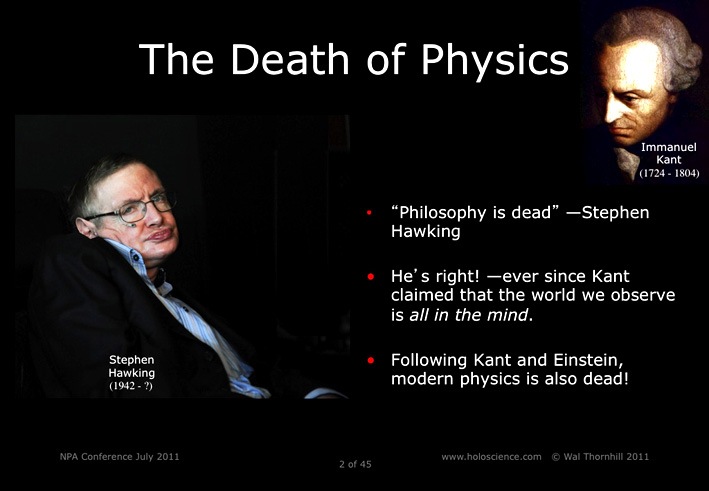
  • How can we understand the world in which we find ourselves? How does the universe behave? What is the nature of  of reality? where did all this come from? Did the universe need a Creator? (…) Traditionally these are questions for philosophy, but philosophy is dead. It has not kept up with modern developments in science, particularly in physics. As a result scientists have become the bearers of the torch of discovery in our quest for knowledge. (Stephen Hawking, Leornard Mlodinow, The Grand Design, Bantam Press, London, 2010, p. 5)

    I fully agree with you about the significance and educational value of methodology as well as history and philosophy of science. So many people today, and even professional scientists, seem to me like someone who has seen thousands of trees but has never seen a forest. A knowledge of the historic and philosophical background gives that kind of independence from prejudices of hi generation from which most scientists are suffering. This  independence created by philosophical insight is, in my opinion, the mark of distinction between a mere artisan or specialist and a real seeker after truth. ( A. Einstein to R. A. Thornton, unpublished letter dated 7 December 1944 (EA 6-574), Einstein Archive, Hebrew University, Jerusalem cited by Don Howard, “Albert Einstein as Philosopher of Science”, Physics Today, December 2005, p. 34.)

  • Într-o lume naturalistă în mecanisme, explicații și țeluri, nu mai există loc de negociere a unei alte realități. Paradoxal însă, într-o lume naturalistă suntem condamnați la solipsism! Reducția pe care se bazează naturalismul ajunge în punctul mort din care credea că Rene Descartes a salvat filosofia: subiectivitatea umană. Ea se află sub vraja doctrinei conform căreia ”orice lucru care nu poate fi perceput cu simțurile este cu siguranță imaginar!”

    ”There is no Narnia, no Overworld, no sky, no sun, no Aslan” decretează regina lumii subterane din The Silver Chair, parte a Cronicilor din Narnia.

    Rupând  vraja naturalismlui crunt al lumii subterane, căreia i-a căzut captiv, personajul Puddleglum îi răspunde:

    Suppose we have only dreamed, or made up, all those things – trees and grass and sun and moon and stars and Aslan himself. Suppose we have. Then all I can say is that, in that case, the made-up things seem a good deal more important than the real ones. Suppose this black pit of a kingdom of yours is the only world. Well, it strikes me as a pretty poor one. And that’s a funny thing, when you come to think of it. We’re just babies making up a game, if you’re right. But four babies playing a game can make a play-world which licks your real world hollow. (C. S. Lewis, The Silver Chair, Macmillan, Collier Books, New York, 1956, p. 159)

    Să ne aducem aminte cum Marco Polo le povestea italienilor depre vizitele sale la curtea lui Kublai Khan ca fiind ceva ce nu poate fi înțeles fără ochii imaginației.

    To speak of “imagining heaven” does not imply or entail that heaven is a fictional notion, constructed by deliberately disregarding the harsher realities of the everyday world. It is to affirm the critical role of the Godgiven human capacity to construct and enter into mental pictures of divine reality, which are mediated through Scripture and the subsequent tradition of reflection and development. We are able to inhabit the mental images we create, and thence anticipate the delight of finally entering the greater reality to which they correspond. (Alister Mc Grath, A Brief History of Heaven, Blackwell, Malden, 2003, p. 5)

    De fapt asta ne spune orice semiotician care studiază imaginarul: semnificațiile și simbolurile nu sunt niciodată rupte de realitatea fizică, ele se dezvoltă împreună cu studiul naturii și al societății dintr-o anumită epocă.

    Tocmai pentru a nu fi absorbiți de visul dominației propriilor percepții, să ne luăm măsura de protecție pe care o are orice psihanalist, aceea ce a avea cel puțin o mînă în afara problemelor pacienților pe care îi consiliază.

    Heaven by Anthony Falbo