

It is well known that we have a scientific censorship that defends the scientific establishment on our times. But what it happens when we have a public retention of knowledge according to its relevance or irrelevance? Who sets the agenda of what is knowledge? After almost 30 years after The Postmodern Condition (J. Fr. Lyotard), we have another report on knowledge in Robert B. Laughlin‘ book, The Crime of Reason: And The Closing of the Scientific Mind, Basic Books, New York, 2008. He argues that the intellectual property laws and government security demands are increasingly restricting access to the most useful information and it threatens the development of new knowledge.
Our society is sequestering knowledge more extensively, rapidly, and thoroughly than any before it in history. Indeed, the Information Age should probably be called the Age of Amnesia because it has meant, in practice, a steep decline in public accessibility of important information. This is particularly ironic given the rise of the Internet, which appears to spectacularly increase access to information but actually doesn’t.
The attitudes about knowledge implicit in this development raise profoundly troubling questions about human beings’ fundamental rights to question and know. More and more, the “flash of insight” that we so admired in Galileo and Newton – the sudden understanding of a thing and its implications – it turning out to be a patent infringement or a state security danger. More and more, the act of reasoning something out for yourself is potentially a crime.
The increasingly conservative legal interpretation of invention as theft echoes our society’s growing ambiguity over how it feels about technical power. We sympathize with the young genius who, in an impetuous act of reason, breaks through the confusion and makes a glorious contribution to knowledge. We also fear the genetic manipulation, nuclear conflict, usurpation of airplanes by terrorists, job export, and so forth that his contributions might facilitate. Unable to decide which is more important to us, we label his acts as criminal, or not, after the fact, according to principles that shift over time and that he didn’t understand when he did his work. He is like the soldier making brave decisions on the battlefield without knowing whether he will receive a commendation or a court-martial. We respect what he stands for but absolutely will not grant him full creative license. Too much is at stake. The irresponsible publication of a trade secret or military technology “discovered” by accident could mean death for a corporation, chaos in the streets, or loss of life in war.
Thus at the dawn of the Information Age we find ourselves dealing with the bizarre concept of the “crime of reason”, the unsocial nature or outright illegality of understanding certain things. Legislatures, with our tacit blessing, have begun writing laws that criminalize understanding and speech because it is easier than criminalizing the behavior they engender. The argument they make, echoing that of previous eras, is that incremental curtailment of freedom is a reasonable price to pay for continued safety and prosperity. We will regulate and censor certain things for your own good. Don’t worry about details. They’re technical. But who will the censors be? To whom will they report?
Unfortunately, the simplistic reflexive response technically informed people make, “liberty or death”, falls on deaf ears. It simply isn’t workable. Our society has already decided, quite firmly, that a growing body of technical understanding shouldn’t be accessible to everybody. We have no option other than to sit down and plan, as best we can, what the rules of knowledge containment will be. That requires informing ourselves of the facts and thinking hard about them, since things you understand incompletely are easy to dismiss as confusing, boring, and irrelevant, even when they aren’t. Sanitized knowledge is also deliberately designed to look this way.
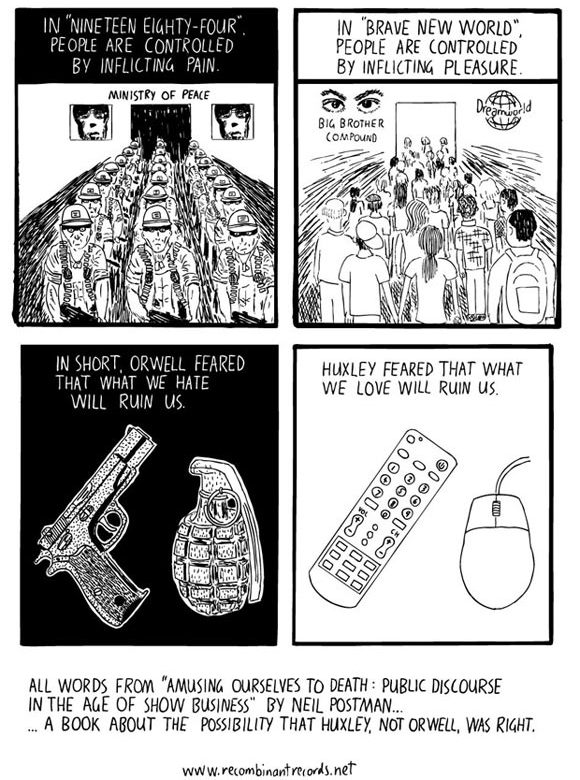
Meanwhile the wiser heads are sorrowful and silent, for they understand the full significance of this moment. It marks the final, terrible demise of Enlightenment optimism. Descartes’ brave declaration, “I think, therefore I am,” has become a satire. We have collectively resolved to relinquish our intellectual rights, to vote them out of existence on the grounds that they are too inconvenient and frightening to live with. The “technical” nature of the banned knowledge is irrelevant. Knowledge is knowledge. Once we accept that some of it is too important for ordinary people to have, we are no longer at Orwell’s doorstep but sitting together in his parlor discussing proper placement of the furniture. That’s not the way many of us wanted it, but that’s the way it is. (p. 5-8)
(…) the right to learn is now aggressively opposed by intellectual property advocates, who want ideas elevated to the status of land, cars, and other physical assets so the their unauthorized acquisition can be prosecuted as theft (p. 138).
 Alonewithothers's Blog
Leave a comment