Atheism is untenable unless it is the case that there is no plausible notion of God worthy of the name (J. Angelo Corlett, 88).
I’ve found J. Angelo Corlett’s book The Errors of Atheism (Continuum, 2010) as an agnostic’s statement on the current state of the debate about God’s existence, being a pertinent critique of the “new atheists”, especially R. Dawkins’s logical errors. On the other hand, Corlett argues for a hybrid minimalist theism, correcting the insufficiency of traditional orthodoxy theology. My special interest reading this book was the errors of atheism, as its title states, summarized in conclusion of the book.
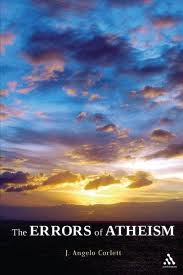
The argument of this book has been that, if orthodox Christian theism suffers from severe implausibility in light of the many problems that it cannot seem to resolve after centuries of defense by some of the most brilliant minds in history, it is a mistake to infer from this supposition that atheism, properly construed, is epistemically justifi ed in a robust sense. For even its most respected proponents commit the errors of atheism.
First, they commit the straw person fallacy of thinking that theism is best understood in terms of the hyperbolic orthodox Christian conception of God’s nature (e.g., omnipotent, omniscient, transcendent, etc.) and function.
Second, atheists tend also to commit the bifurcation fallacy in thinking that either orthodox Christian theism is sound, or atheism must be the result, when in fact there are more plausible conceptions of theism than the orthodox Christian one.
Third, they often tend to commit a fallacy of equivocation between atheism and agnosticism in attempting to stipulatively define “atheism” in probabilistic terms, and arbitrarily, when in fact agnosticism just is the view that construes the existence of God (among other things) probabilistically.
Finally, they tend also to commit the fallacy of hasty conclusion insofar as atheists reason that the orthodox Christian theistic view of the nature of God is representative, with its numerous attendant problems, of what a viable theism must be vis-à-vis the nature of God.
Thus even if orthodox Christian theism is highly problematic, atheism is not at this time a justifi ed inferential position to adopt for the serious thinker. Atheism cannot justify itself unless and until it is the case that significant and unresolved problems arise for theisms of the most plausible varieties—especially ones that can evade many or all of the difficulties posed by atheism to orthodox Christian theism. Contrary to both orthodox Christian theism and atheism, then, neither of such views is plausible in light of the current state of the evidence, and the New Agnosticism is the most justified position for the time being.
What partly underlies the errors of atheism is the thoroughgoing “double-duping” by orthodox Christian theism of unsuspecting parishioners, on the one hand, and atheists, on the other, into thinking that the Christian brand of theism is worthy of the amount of attention it has received. Moreover, part of this double-duping has succeeded in persuading atheists to think that the orthodox conception of the nature of God is the only one worthy of our serious philosophical attention. This idea plays into the atheist’s agenda of easily refuting the idea of God without delving more deeply into the problem of God (J. Angelo Corlett, The Errors of Atheism, Continuum, 2010, 225, emphasis mine).


 Alonewithothers's Blog
Leave a comment