A thesis:
When ethics of biblical interpretation are determined by religious divisions and political reasons, plus effects of humanism and its hyper-rational discursive platform, then we have a textualization and multiple strategies of relativism (as a secularization of authority).
And a hilarious paradox:
the maximization of reason and the weakness of the authority of Scriptures led to weakness of reason and hyper-individualism and hedonism (as new authorities).
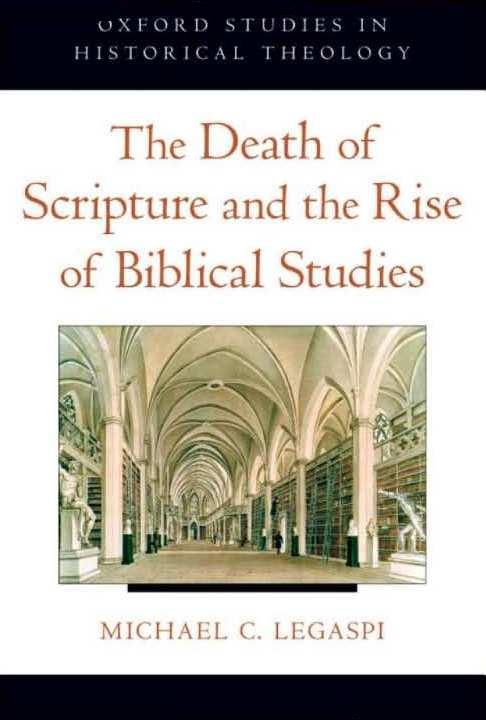
Scripture died a quiet death in Western Christendom some time in the sixteenth century. The death of scripture was attended by two ironies. First, those who brought the scriptural Bible to its death counted themselves among its defenders. Second, the power to revivify a moribund scriptural inheritance arose not from the churches but from the state. The first development was the Reformation, and the second was the rise, two hundred years later, of modern biblical scholarship.
For over a millennium, Western Christians read and revered the Christian Bible as Scripture, as an authoritative anthology of unified, authoritative writing belonging to the Church. The scriptural Bible was neither reductible to a written “text” nor intelligible outside a divine economy of meaning. It was not simply the foundation of the Church’s academic theology; it also furnished its moral universe, framed its philosophic inquiries, and fitted out its liturgies. It provided the materials for thought, expression, and action, becoming what Northrop Frye famously called the “great code” of Western civilization. As the book at the center of Western Christendom, the Bible functioned scripturally. However, in the wake of the traumatic religious divisions of the sixteenth century, the fractured Church ceased to be a unified body capable of maintaining a coherent claim on the Bible as its Bible. Because both Roman Catholics and Protestants claimed the Bible, in different ways, as their own, the Bible could no longer function unproblematically as Scripture. Its nature and authority had to be explicated and legitimated with reference to extrascriptural concepts, whether juridically, as among Catholics, or doctrinally, as among Protestants. Over the course of the post-Reformational controversies, the Bible showed itself to be a contested legacy for Western Christians, ultimately devolving into a multiplicity of bibles with distinct canons, separate ecclesial contexts, and prolific theological superstructures. What had functioned centrally in the life of the Church became, in the early modern period, a kind of textual proving ground for the legitimacy of extrascriptural theoretical understandings: at first theological and polemical and then, over time, literary, philosophical, and cultural. As a text, an object of critical analysis, the Bible came into clearer focus; however, as Scripture, the Bible became increasingly opaque.(Michael C. Legaspi, The Death of Scripture and the Rise of Biblical Studies, Oxford University Press, 2010, p. 3-4, emphasis mine)


 Alonewithothers's Blog
Leave a comment