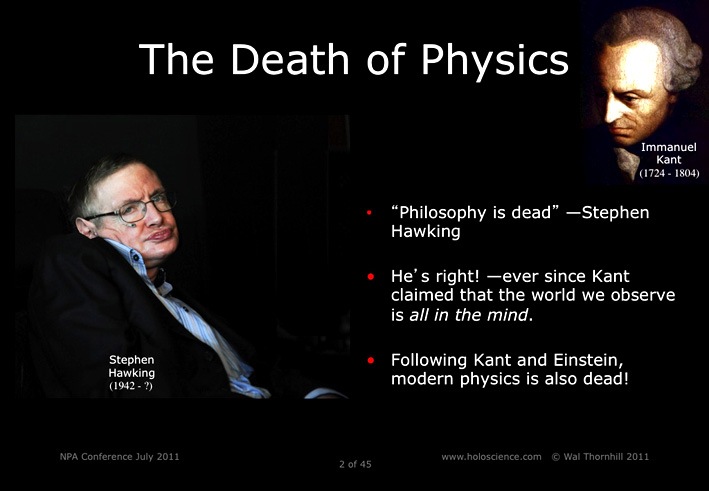
How can we understand the world in which we find ourselves? How does the universe behave? What is the nature of of reality? where did all this come from? Did the universe need a Creator? (…) Traditionally these are questions for philosophy, but philosophy is dead. It has not kept up with modern developments in science, particularly in physics. As a result scientists have become the bearers of the torch of discovery in our quest for knowledge. (Stephen Hawking, Leornard Mlodinow, The Grand Design, Bantam Press, London, 2010, p. 5)
I fully agree with you about the significance and educational value of methodology as well as history and philosophy of science. So many people today, and even professional scientists, seem to me like someone who has seen thousands of trees but has never seen a forest. A knowledge of the historic and philosophical background gives that kind of independence from prejudices of hi generation from which most scientists are suffering. This independence created by philosophical insight is, in my opinion, the mark of distinction between a mere artisan or specialist and a real seeker after truth. ( A. Einstein to R. A. Thornton, unpublished letter dated 7 December 1944 (EA 6-574), Einstein Archive, Hebrew University, Jerusalem cited by Don Howard, “Albert Einstein as Philosopher of Science”, Physics Today, December 2005, p. 34.)


 Alonewithothers's Blog
Leave a comment