Philosophical Foundations (a. Ancient Roots)
The Age of Intellectual Maturity
In The Republic (Book VII, 539b-540a), Plato discusses the age and maturity necessary for one to attain the status of a philosopher. Beyond a contrarian, superficial, or mimetic spirit, a thinker truly becomes a philosopher only when he surpasses the stage of immaturity (to use Kantian terms), characterized by an unjustified, reckless, and uncontrolled use of the dialectical and contrarian spirit:
“539B For I presume you have noticed that youngsters, when they first get a taste of dialectic, misuse it as if it was their plaything, by using it always to come up with counterarguments. They themselves imitate those who engage in refutation, by refuting other people, taking delight, like puppies, in verbally tugging at and pulling apart anyone who ever comes near them.”
[…]
“And so, when they themselves have refuted many, and have been refuted 539C by many, they descend rapidly and inexorably to a state where they believe nothing they believed before, and as a consequence they themselves, and philosophy in general, are held in low regard by everyone else.” (539B, C)
In ancient Greece, the optimal age to begin engaging in philosophy was around 40 years old, following intense cultivation of the mind through mathematical exercises and of the body through athletic training. Aristotle also speaks of the optimal age for philosophizing—around 40 years old—situated between the impulsiveness of youth and the cynicism of old age (Rhetoric, Book II, Chapter 14). This is because practical intelligence (phronesis) is required. According to Aristotle, this should be the peak, the optimal age of balance (mesótēs)—courageous but not recklessly daring, prudent but not timid.
Perhaps the deplorable state of today’s public intellectuals, despite the spectacle and public reputation of some figures within the intellectual class, can be explained by the failure to adhere to these minimal conditions prescribed to us for so long.
Philosophy and Democracy – The Twin Pillars of Intellectual Spirit
But let us go even further back in history, beyond Aristotle and Plato, to the turbulent era of democracy’s birth, which, to a great extent, coincides with the birth of philosophy. According to French scholars Marcel Detienne and Jean-Pierre Vernant, the transition from mythical, exclusively lyrical and poetic thought—used to justify centralized, authoritarian, and hierarchical power structures (as seen in the dominance of despots, aristocrats, and monarchy in the pre-philosophical era)—to philosophical, rational thought centered not around the word of power (mythos), but the power of the word (logos), was a crucial shift. This transition led to open, interrogative, and participatory discourse, resembling the agora, reflecting the symmetry of the cosmos (an order that implies reason and harmony) (see Jean-Pierre Vernant, Myth and Thought in Ancient Greece; Marcel Detienne, The Masters of Truth in Archaic Greece).
The decline of aristocratic and despotic authority in the 6th century BCE, which had justified itself through grand mythological narratives and hierarchical power structures, made way for the city-state (polis), organized around the citizens’ freedom to express opinions, open critique, public participation, and debate. The rationalization of religious experience and mythological traditions gave birth to classical Greek philosophy (J.-P. Vernant), just as the concept of truth shifted from poetic and religious experience to a philosophical one—open to debate and consensual acceptance based on reason and rational arguments (M. Detienne).
Note: I will discuss the limitations of this explanatory model when referring to the acrobats of reason in the Greek demos, the sophists, and their present-day counterparts.
In this context, an intellectual is neither a poet nor a priest, but a craftsman of possibilities, a handler of rational truth—a mind that perceives its own limitations just as it perceives those of others. The intellectual negotiates options in the public sphere with those holding different opinions and perspectives. An intellectual is an advocate of dialogue, not of authoritarian refusal to justify beliefs or to appeal to reason – understood as an intersubjective means of discussing individual absolutes.
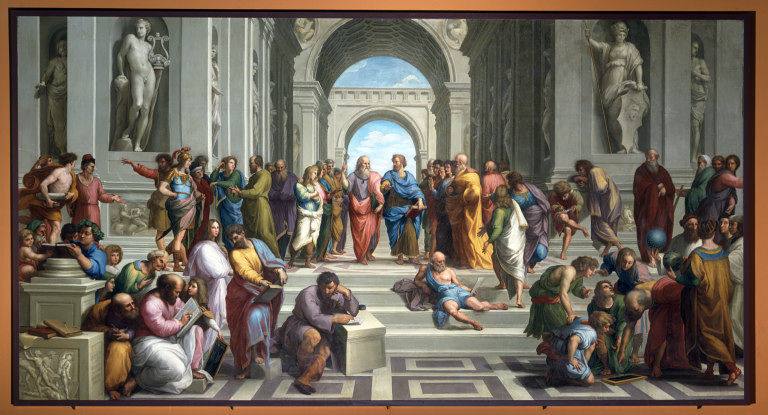
However, history offers us a fascinating spectacle: the journey from the stage of independence and adolescent optimism (pre-Socratic philosophers up to Socrates), through the classical, emphatic, stable maturity of philosophy (Plato, Aristotle), to the senility of ancient philosophy—consumed either by Roman philosophical cynicism, Greek atheistic Epicureanism, or the religious mysticism of Neoplatonic sects. A cycle that will repeat, in some form, in modern times: breaking free from the paternalistic captivity of medieval Christian Scholasticism, modern philosophy rises like a vigorous and optimistic young force during the Enlightenment, championing reason (or sensory experience)—with Kant playing the synthesizing role that Plato had in antiquity (albeit delivering a fatal blow to philosophy). It then enters the senility of postmodern cynicism, displaying a religious fervor, visible even in its passionate anti-religiosity.
Are we now living in a time of intellectual revival, rekindling the rational spirit after the nihilistic hangover of postmodern heresies?
Before approaching the modern era, however, we must first spend more time in Plato’s domain—the first true advocate of the public intellectual, the one who sought to dominate society through the power of reason and moral example. Here, we will observe both the grandeur and corruption that history unfolds before our eyes, with the hope that we may learn something from it…
 Alonewithothers's Blog
Leave a comment