Prolegomena for an uncomfortable exercise
In Matthew 15:14, Jesus, the carpenter from a dusty little village in northern ancient Israel, just had a confrontation with the Pharisees and scribes who had come all the way from Jerusalem. When his disciples expressed some concerns that their teacher had offended these highly respected intellectual elites, Jesus responded: “Leave them; they are blind guides. If the blind lead the blind, both will fall into a pit.” (NIV)
Beyond what we might today label as abrupt, impolite, or even obtuse rhetoric, the core issue here resonates with a theme later picked up (reversed, upside-down, in an self-glorifying, narcissistic manner) by the Enlightenment: what happens when intellectuals—those meant to bring the light of revelation or reason—willingly wallow in the darkness of their own blindness and ignorance?
Setting aside the all-too-convenient interpretation of this passage as some sort of anti-intellectualist stance, often exploited for mercantile or political purposes, we are left with an inescapable fundamental question: what happens to the rest of us—the public, the common people—when the so-called beacons of intellectual and spiritual light fail to fulfill their mission? From the biblical text, we see that Jesus not only critiques these intellectuals’ inability to perceive the light but also highlights conformism, the herd mentality that thrived within the so-called “intellectual community” of his time.
On that note, the Gospels do offer positive examples of highly esteemed, intelligent, and publicly reputable figures who were received—and even appreciated—by Jesus. Think of Nicodemus, Joseph of Arimathea, and other Pharisees who believed in secret. Yet, in every instance, these individuals were overshadowed by their fear of being ostracized and punished by their own community. So, the next time a young person says the Gospels aren’t cool or that there’s nothing in them worthy of a rebellion against “the system”, they might want to take another look.
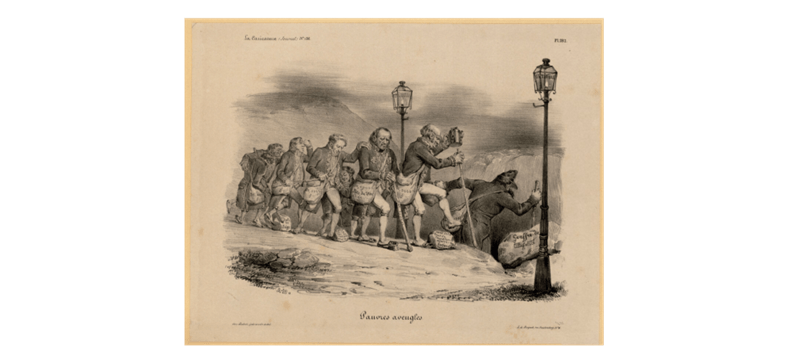
Blind Leading the Blind (Povre Aveugles) by Auguste Desperret, mid 1800s
So, how should we evaluate the performance, value, and public role of intellectuals in our time?
I will attempt to bring some light to this matter as someone who, despite a personal diminished public profile in recent years, has remained connected to the flow of ideas and the public spectacle in North America and, through various channels, to that of Romania. This distance has given me the ability to observe trends and shifts—sometimes abrupt ones—in positions and justifications I never expected to hear from individuals of strong intellectual and moral standing.
What is happening to intellectuals (some, but not a few) and the light they claim to carry, only to end up blind, as in the biblical passage? Is that light illusory, toxic, a hybrid darkness disguised as illumination? Is it something about how they receive and process that light? Or is it possible that we, those meant to receive their wise counsel, lack the light to perceive their light? (Perhaps that is why the psalmist says, “In Your light, we see light”—Psalm 36:9. This, I believe, is the precondition of the intellectual, as it is for anyone else: humility, an honest awareness of one’s limitations, and a willingness to receive before attempting to give to others. If we do not consider the Bible a serious source, then let us turn to Socrates, who spoke of the same principle—awareness of one’s own ignorance as the precondition for the path to knowledge. A “I know that I know nothing” does not sit well with today’s polished rhetoric, refined oratory, or intellectual elitism—hence why the Romanian playwright I. L. Caragiale remains so relevant!)
This endeavor will require, first and foremost, some archaeological and diagnostic work, examining the history of the “patient.” Additionally, we will undertake efforts to explore therapeutic options, preventing ourselves from becoming—or deconverting from the status of—the blind leading the blind while believing ourselves to be the bearers of light.
In other words, my approach aims to clarify the status and mandate of the intellectual in the public sphere, following a very simple structure:
- Philosophical Foundations
Defining the public intellectual while outlining the philosophical underpinnings of various available options in the public arena.
What is a public intellectual?
Who are the intellectuals whose voices dominate the public space?
What explicit motivations, standards, and justifications do these intellectuals offer us?
This will be an uncomfortable and risky exercise in shedding some light on those who teach us how to direct light onto others.
- The Ideological Clone Factory
A call for honesty, with an insistent look at the mechanisms shaping public opinion.
How is consensus manufactured (to borrow Noam Chomsky’s phrase)?
What forces and tools are used to standardize and reshape cultural climates?
How do mental toys (a.k.a. ideological preciousness) trickle down from university professors into media, schools, public discourse, and even private family discussions, parasitizing our thinking, capturing public opinion, and subtly censoring our ability to think divergently—or even contradictorily?
- Lessons from the Past
A radiography of the great moral failures of intellectuals who have become instruments of ideological uniformity and political forces.
How can we analyze past intellectual servility and prostitution, not with resentment, but as a lesson for understanding the same dynamics in today’s world?
In contrast, we will take a look at some intellectuals who maintained integrity, character, and independence. They might play as role models for us, here and now.
- What Is to Be Done?
A possible therapeutic roadmap—one I present for debate—in the hope that we can reach a minimal ethical standard for those who consider themselves intellectuals and engage in socio-cultural engineering.
What are the minimum intellectual hygiene conditions that should be met before we grab the megaphone and preach to others?
Before diving into this analysis, I must clarify that this exercise is strictly surgical—a methodological demonstration for analysis and evaluation, avoiding direct applications to particular contemporary events. I will intentionally refrain from referencing current affairs so as not to get caught up in the partisan passions of daily politics.
My intent is as academic and invitational as possible. That being said, we will walk hand in hand through the DO’s and DON’Ts of intellectual discourse, with the guidance of J. Benda, M. Foucault, A. Gramsci, K. Marx, J. Dewey, R. Rorty, Z. Bauman, J. Kristeva, S. Žižek, A. Davis, J. Butler, R. Aron, A. Bloom, M. Heidegger, J.-P. Sartre, B. Weiss, T. Sowell, J.S. Mill, H. Marcuse, and others. (Notice the overwhelming dominance of intellectuals with a particular philosophical and ideological orientation—this is an intentional move, a playful deconstruction, an argumentative inversion, a dialectical reversal—see ἐνθύμημα – enthymeme, as recommended by Aristotle over two thousand years ago.)
Perhaps my effort will open bridges—not only of communication but also of divergent, freer, and more independent analysis, so necessary to the intellectual condition.
After all, was the Garden of Eden ever really a safe place for Adam and Eve?
- Philosophical Foundations
a) Ancient Roots
The Age of Intellectual Maturity
In The Republic (Book VII, 539b-540a), Plato discusses the age and maturity necessary for one to attain the status of a philosopher. Beyond a contrarian, superficial, or mimetic spirit, a thinker truly becomes a philosopher only when he surpasses the stage of immaturity (to use Kantian terms), characterized by an unjustified, reckless, and uncontrolled use of the dialectical and contrarian spirit:
“539B For I presume you have noticed that youngsters, when they first get a taste of dialectic, misuse it as if it was their plaything, by using it always to come up with counterarguments. They themselves imitate those who engage in refutation, by refuting other people, taking delight, like puppies, in verbally tugging at and pulling apart anyone who ever comes near them.”
[…]
“And so, when they themselves have refuted many, and have been refuted 539C by many, they descend rapidly and inexorably to a state where they believe nothing they believed before, and as a consequence they themselves, and philosophy in general, are held in low regard by everyone else.” (539B, C)
In ancient Greece, the optimal age to begin engaging in philosophy was around 40 years old, following intense cultivation of the mind through mathematical exercises and of the body through athletic training. Aristotle also speaks of the optimal age for philosophizing—around 40 years old—situated between the impulsiveness of youth and the cynicism of old age (Rhetoric, Book II, Chapter 14). This is because practical intelligence (phronesis) is required. According to Aristotle, this should be the peak, the optimal age of balance (mesótēs)—courageous but not recklessly daring, prudent but not timid.
Perhaps the deplorable state of today’s public intellectuals, despite the spectacle and public reputation of some figures within the intellectual class, can be explained by the failure to adhere to these minimal conditions prescribed to us for so long.
Philosophy and Democracy – The Twin Pillars of Intellectual Spirit
But let us go even further back in history, beyond Aristotle and Plato, to the turbulent era of democracy’s birth, which, to a great extent, coincides with the birth of philosophy. According to French scholars Marcel Detienne and Jean-Pierre Vernant, the transition from mythical, exclusively lyrical and poetic thought—used to justify centralized, authoritarian, and hierarchical power structures (as seen in the dominance of despots, aristocrats, and monarchy in the pre-philosophical era)—to philosophical, rational thought centered not around the word of power (mythos), but the power of the word (logos), was a crucial shift. This transition led to open, interrogative, and participatory discourse, resembling the agora, reflecting the symmetry of the cosmos (an order that implies reason and harmony) (see Jean-Pierre Vernant, Myth and Thought in Ancient Greece; Marcel Detienne, The Masters of Truth in Archaic Greece).
The decline of aristocratic and despotic authority in the 6th century BCE, which had justified itself through grand mythological narratives and hierarchical power structures, made way for the city-state (polis), organized around the citizens’ freedom to express opinions, open critique, public participation, and debate. The rationalization of religious experience and mythological traditions gave birth to classical Greek philosophy (J.-P. Vernant), just as the concept of truth shifted from poetic and religious experience to a philosophical one—open to debate and consensual acceptance based on reason and rational arguments (M. Detienne).
Note: I will discuss the limitations of this explanatory model when referring to the acrobats of reason in the Greek demos, the sophists, and their present-day counterparts.
In this context, an intellectual is neither a poet nor a priest, but a craftsman of possibilities, a handler of rational truth—a mind that perceives its own limitations just as it perceives those of others. The intellectual negotiates options in the public sphere with those holding different opinions and perspectives. An intellectual is an advocate of dialogue, not of authoritarian refusal to justify beliefs or to appeal to reason – understood as an intersubjective means of discussing individual absolutes.
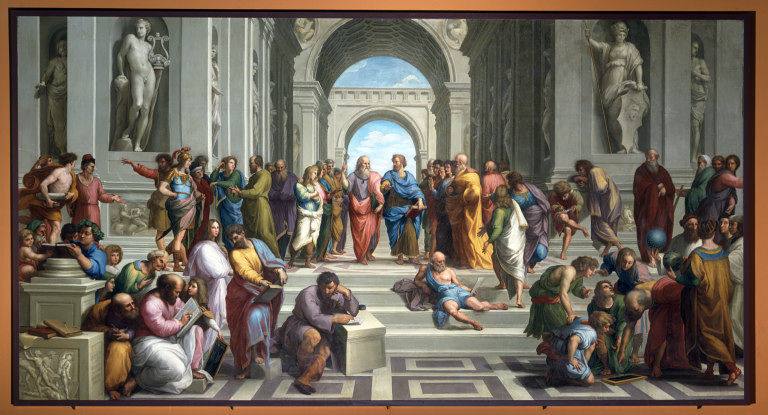
However, history offers us a fascinating spectacle: the journey from the stage of independence and adolescent optimism (pre-Socratic philosophers up to Socrates), through the classical, emphatic, stable maturity of philosophy (Plato, Aristotle), to the senility of ancient philosophy—consumed either by Roman philosophical cynicism, Greek atheistic Epicureanism, or the religious mysticism of Neoplatonic sects. A cycle that will repeat, in some form, in modern times: breaking free from the paternalistic captivity of medieval Christian Scholasticism, modern philosophy rises like a vigorous and optimistic young force during the Enlightenment, championing reason (or sensory experience)—with Kant playing the synthesizing role that Plato had in antiquity (albeit delivering a fatal blow to philosophy). It then enters the senility of postmodern cynicism, displaying a religious fervor, visible even in its passionate anti-religiosity.
Are we now living in a time of intellectual revival, rekindling the rational spirit after the nihilistic hangover of postmodern heresies?
Before approaching the modern era, however, we must first spend more time in Plato’s domain—the first true advocate of the public intellectual, the one who sought to dominate society through the power of reason and moral example. Here, we will observe both the grandeur and corruption that history unfolds before our eyes, with the hope that we may learn something from it…
 Alonewithothers's Blog