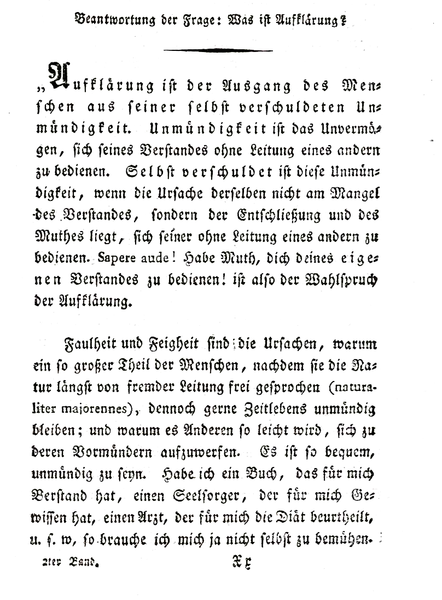
1. 30 septembrie 1784 – eseul Beantwortung der Frage: Was ist Aufklärung?, unde I. Kant scrie declaraţia manifest a glorioasei autonomii a omului raţional, începe astfel:
Enlightenment is man’s emergence from his self-incurred immaturity. Immaturity is the inability to use one’s own understanding without the guidance of another. This immaturity is self-incurred if it cause is not lack of understanding, but lack of resolution and courage to use it without the guidance of another. The motto of the Enlightenment is therefore: Sapere aude! Have courage to use your own understanding!
(Immanuel Kant, An Answer to the Question: What is Enlightenment in What is Enlightenment? Eighteenth-Century Answers and Twentieth-Century Questions, ed. James Schimdt, University of California Press, Berkeley, 1996, p. 58-59)
 2. 1955 – mărturia unui om care a simţit din plin ieşirea din starea de minorat a omului luminat, creaţie a unui popor recunoscut pentru soliditatea practicării demersului raţional:
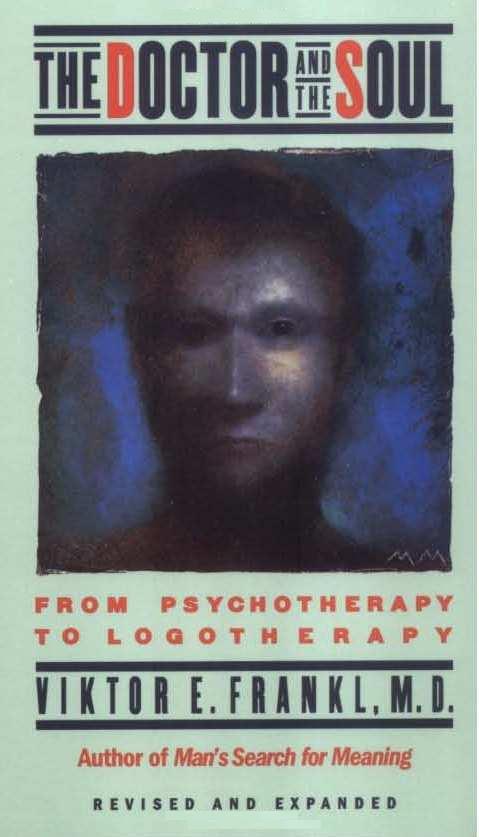
If we derive the ego from the id and the super/ego from the id plus ego, what we achieve is not a correct picture of man, but a caricature of man. The results sound like a tall story by Baron Munchhausen, with the ego pulling itself out of the bog of the id by its own super-ego bootstraps.
If we present a man with a concept of man which is not true, we may well corrupt him. When we present man as an automaton of reflexes, as a mind-machine, as a bundle of instinct, as a pawn of drives and reactions, as a mere product of instinct, heredity, and environment, we feed the nihilism to which modern man is, in any case, prone.
I became acquainted with the last stage of that corruption in my second concentration camp, Auschwitz. The gas chambers of Auschwitz were the ultimate consequence of the theory that man is nothing but the product of heredity and environment – or, as the Nazi liked to say, of “Blood and Soil”. I am absolutely convinced that the gas chambers of Auschwitz, Treblinka, and Maidenk were ultimately prepared not in some Ministry or other in Berlin, but rather at the desks and in the lecture halls of nihilistic scientists and philosophers.
(Viktor Emil Frankl, The doctor and the soul: From Psychotherapy to Logotherapy, Random House New York, second Vintage Books Edition, 1986, p. xxvii, emphasis mine)
 Astăzi nu ne rămâne decât să facem savante note de subsol la cele două momente enumerate mai sus. Tindem însă să negăm orice legătură cauzală dintre ele, ceea ce dovedeşte că, oricât ne-am mândri cu apetenţa orgoliului nostru, asezonat superdoct cu formulări filosofice, nu prea am ieşit din starea de minorat. Dovedim astfel o uimitoare credinţă în utopii falimentare, refuzând crudele evidenţe empirice de sub ochii noştri.

 Alonewithothers's Blog
Leave a comment